
Chart of the month: Gold, Gold, Gold. Switzerland the quiet giant.

Gold, Gold, Gold. Switzerland the quiet giant.


gold Switzerland
Source: World Gold Council, Swiss Federal Statistical Office, Bloomberg, NS Partners. Image generated by artificial intelligence based on author-provided content.


The gold rush is back. Gold has climbed to new record highs, emerging as the top-performing asset class year-to-date, with gains above +50% in USD. From private investors to central banks, demand has surged across the board.

Gold remains an ultimate hedge against inflation, currency debasement and uncertainty, a safe harbor when markets tremble. Amid the global search for safety, Switzerland stands out as a quiet pillar of strength.

Did you know that Switzerland holds more gold per capita than any other country in the world?

The Swiss National Bank currently holds around 1,040 tonnes of gold, equivalent to roughly 100 billion Swiss francs in value, placing Switzerland seventh worldwide in total holdings. On a per capita basis, this corresponds to about 118 grams of gold per Swiss resident, which is the highest ratio in the world. Although the Swiss franc has not been backed by gold since 1999, the Swiss National Bank continues to maintain substantial reserves. This reflects Switzerland’s enduring tradition of financial prudence, stability and independence.

This impressive reserve position has a measurable impact. In 2024, the rise in gold prices generated an unrealized gain of CHF 21.2 billion, contributing significantly to the Swiss National Bank’s record profit of around CHF 80 billion. In early 2025, gold prices surged further, adding CHF 12.8 billion in valuation gains in the first quarter, partially offsetting foreign currency headwinds. By mid-2025, after a moderate correction in gold prices, unrealized gains stood at CHF 8.6 billion, confirming gold’s role as a key stabilizing factor in the Swiss National Bank’s balance sheet.

Switzerland’s strength extends well beyond its reserves. The same principles that underpin its monetary discipline are visible across the real economy. A focus on high value-added sectors such as pharmaceuticals, chemicals, machinery and precision engineering has built a foundation of sustainable growth and innovation, rather than reliance on low-margin industries such as automotive.

Resilience is not only an economic story; it is also a market story. Switzerland is a strong economy, with a resilient industry and a robust financial market. Over the past decade, Swiss small and mid-caps have shown consistent outperformance. While this momentum has moderated over the past five years, performance has reaccelerated over the most recent twelve months. Still, it is precisely within Swiss small and mid-caps that the most attractive opportunities reside, featuring hidden champions and niche innovators offering long-term value potential.


Past performance is not indicative of future results. The views, strategies and financial instruments described in this document may not be suitable for all investors. Opinions expressed are current opinions as of date(s) appearing in this material only. References to market or composite indices, benchmarks or other measures of relative market performance over a specified period of time are provided for your information only. NS Partners provides no warranty and makes no representation of any kind whatsoever regarding the accuracy and completeness of any data, including financial market data, quotes, research notes or other financial instrument referred to in this document. This document does not constitute an offer or solicitation to any person in any jurisdiction in which such offer or solicitation is not authorized or to any person to whom it would be unlawful to make such offer or solicitation. Any reference in this document to specific securities and issuers are for illustrative purposes only, and should not be interpreted as recommendations to purchase or sell those securities. References in this document to investment funds that have not been registered with the FINMA cannot be distributed in or from Switzerland except to certain categories of eligible investors. Some of the entities of the NS Partners Group or its clients may hold a position in the financial instruments of any issuer discussed herein, or act as advisor to any such issuer.  Additional information is available on request.
© NS Partners Group

Swiss industry: stability amid uncertainty

A driver of growth and a source of added value, Swiss industry deserves its place in investment portfolios.

Often seen as a service-driven economy, Switzerland in fact rests on a solid and diversified industrial base. Key sectors such as pharmaceuticals, chemicals, machinery, metalworking and electricity generation make up a robust export-oriented industrial ecosystem that plays a decisive role in the country’s wealth creation. In 2024, the secondary sector made up 24.7% of GDP, an unusually high figure for a developed economy, exceeding the European Union average.

A Remarkable Trajectory, Despite a Strong Franc
The Swiss franc, long considered a traditional safe-haven asset, has strengthened versus other major global currencies. In theory, this trend should undermine export competitiveness, yet it has not hindered the momentum of Swiss industry. In fact, over the past 15 years, Swiss industrial production has shown steady growth. In Q1 2025, it rose by +8.5% year-over-year. Even more striking, industrial output has grown by nearly 40% since 2010 despite the franc strengthening by over 25% relative to the euro. What explains such performance? Much of it lies in the structure of Swiss industry itself. The absence of a large automotive sector, combined with a focus on high value-added niches, gives Swiss industry greater resilience to external shocks and the ability to export specialized goods that continue to be in high demand globally.

Understanding the Swiss Industry Landscape

Switzerland Generates Far More Value Per Exported Unit than China
While China remains the world’s largest industrial producer by volume, Switzerland stands out through its much higher value-added intensity. In 2024, Switzerland’s per capita trade surplus was nearly 12 times higher than China’s. This momentum also sets Switzerland apart within Europe. Industrial growth here has been significantly more robust than in most major European economies, including Germany.

U.S. Trade Policy: Ongoing Uncertainty
In 2025, one of the key external risks remains the trade policy of the United States. Tariff measures announced by Donald Trump prompted many companies to bring forward deliveries into Q1, contributing to GDP growth for the period. In response to this uncertain climate, Swiss companies are adopting various adaptation strategies: price adjustments, partial reshoring of value chains, and geographic diversification, even as hopes persist for a bilateral agreement. Diplomatic pressure is mounting and drawing firm conclusions in such a fluid environment remains risky. However, Switzerland’s focus on differentiated products suggests the country will continue to adapt effectively.

A Strategic Long-Term Positioning
Despite international economic uncertainty, Swiss industry, driven by niche leaders, a culture of constant innovation and a highly skilled workforce makes a strong case for long-term strategic exposure in investment portfolios. Whether facing a strong franc or trade tensions with the U.S., Swiss firms are quick to adapt. Even in a context of global slowdown, Switzerland continues to maintain a healthy trade surplus. This reflects the structural resilience of its industrial model.


Past performance is not indicative of future results. The views, strategies and financial instruments described in this document may not be suitable for all investors. Opinions expressed are current opinions as of the date(s) appearing in this material only. References to market or composite indices, benchmarks or other measures of relative market performance over a specified period of time are provided for your information only. NS Partners provides no warranty and makes no representation of any kind whatsoever regarding the accuracy and completeness of any data, including financial market data, quotes, research notes or other financial instruments referred to in this document. This document does not constitute an offer or solicitation to any person in any jurisdiction in which such offer or solicitation is not authorized or to any person to whom it would be unlawful to make such offer or solicitation. Any reference in this document to specific securities and issuers are for illustrative purposes only, and should not be interpreted as recommendations to purchase or sell those securities. References in this document to investment funds that have not been registered with the Finma cannot be distributed in or from Switzerland except to certain categories of eligible investors. Some of the entities of the NS Partners group or its clients may hold a position in the financial instruments of any issuer discussed herein, or act as advisor to any such issuer. Additional information is available on request.  © NS Partners Group

Swiss equities: resilient, diverse and poised for growth

A unique blend of stability, specialization, and long-term performance defines Switzerland’s investment landscape.

Switzerland’s equity market stands as a quiet powerhouse within the global investment arena. Renowned for its political neutrality, monetary prudence and economic resilience, the country offers investors a rare combination of safety and structural growth. While many investors are familiar with its multinational champions, Switzerland also offers a dynamic and diverse universe of mid- and small-cap companies that are often global leaders in their specialized niches.

A Prime Investment Opportunity

Amid persistent global economic headwinds, Switzerland continues to shine as a beacon of macroeconomic stability. Recent macroeconomic indicators confirm the robustness of the Swiss economy. The Swiss National Bank (SNB) anticipates GDP growth of between 1% and 1.5% for the current year. The SNB maintains a balanced policy stance, and negative short-term yields point to potential rate cuts that could further support equities. Currency dynamics reinforce the attractiveness of Swiss assets. The Swiss franc remains strong. This strength reflects investor confidence in Switzerland’s macroeconomic foundations and offers international investors a natural hedge in volatile markets.

Defensive by Design, with Long-Term performance

At the large-cap level, the Swiss Market Index (SMI) is heavily weighted toward defensive sectors. Global leaders like Nestlé, Roche and Novartis provide earnings visibility, dividend reliability and resilience in turbulent markets. The SMI’s consistent resilience has established it as a cornerstone of defensive equity strategies, offering stability and reliable performance through market cycles.
Over the past decade, Swiss small- and mid-cap equities, as represented by the SPI Extra Index (SPIEX), have outperformed the Swiss Market Index (SMI). However, during the most recent market cycle, SPIEX underperformed, presenting a compelling recovery opportunity for forward-looking investors.

The Untapped Potential of Mid and Small-Cap Swiss Stocks

Beyond the headline giants lies a thriving ecosystem of over 190 listed mid- and small-cap companies, many of which are global leaders in highly specialized segments. This includes firms such as VAT Group, which supplies vacuum valves to the semiconductor industry, Belimo, a world leader in HVAC automation and Siegfried Holding, a contract manufacturer for the global pharmaceutical sector. These companies are not only highly specialized but also financially robust, often combining strong free cash flow with low leverage and disciplined capital allocation.
While small- and mid-caps naturally carry higher liquidity risk and occasional valuation premiums, the growth-to-risk trade-off remains compelling, especially in a country with such disciplined governance and transparency standards.

Strategic Sector Exposure

Switzerland’s equity market is structurally overweight in defensive sectors. Compared to the MSCI All Country World Index, where defensives represent less than 20%, the Swiss market stands at over 65%. This offers investors a rare opportunity to gain long-duration exposure to non-cyclical sectors such as healthcare, food and beverage, and insurance.
Meanwhile, exposure to high-growth themes is embedded in Switzerland’s mid-cap space: biotech, medtech, sustainable construction, fintech and advanced manufacturing all feature prominently.

A Note on Sustainability

While not always at the forefront of equity narratives, ESG and sustainability are deeply embedded in the Swiss corporate culture. Most Swiss-listed companies, large and small, publish detailed ESG reports and actively incorporate long-term environmental goals. The country itself draws the bulk of its electricity from renewable sources, notably hydropower, and leads Europe in carbon footprint transparency.
As investors increasingly integrate ESG considerations into capital allocation, Switzerland offers a highly aligned investment landscape.

Depth Beyond the Headlines

As concerns rise, the investment landscape remains notably resilient. Meanwhile, the broader economic outlook is cautiously optimistic: the State Secretariat for Economic Affairs (SECO) forecasts a 1.4% GDP growth (adjusted for sporting events. The Swiss National Bank’s pragmatic and flexible monetary policy further supports the investment environment, while sustainable assets and corporate bonds maintain their appeal in diversified portfolios. These dynamics create a backdrop where selectivity and long-term perspective are rewarded. Despite the challenges of a strong franc and ongoing global trade tensions, Switzerland continues to stand out for its historical market resilience, economic strength, institutional quality and sectoral diversity. Swiss equities, particularly beyond the large-cap names in the SMI, offer strategic exposure to a blend of defensive stability and innovation-led growth. Switzerland is no longer just a safe haven; it is a structurally sound, forward-looking market. For investors ready to look beyond the familiar, it offers access to some of the world’s most innovative and well-managed companies, hidden in plain sight, yet central to the portfolios of the future.

At NS Partners in our Swiss Excellence strategy, we recognize and harness Swiss strength. Our strategy blends exposure to Switzerland’s blue-chip multinationals with a concentrated portfolio of 45 stocks, including 26 high-quality small and mid-sized companies outside the SMI, striking a balance between stability and growth potential. Our investment approach is based on fundamental quality and long-term value creation. We focus on companies with sustained earnings momentum, reasonable valuations relative to growth (PEG discipline), strong free cash flow generation and solid balance sheets. The result is a portfolio that has outperformed Switzerland’s three largest companies in price return since inception, while offering significantly greater exposure to innovation, growth sectors and underappreciated names.

Chart of the month: From safe haven to power play: the Swiss market unleashed

From safe haven to power play: the Swiss market unleashed

Source: Bloomberg, NS Partners


Switzerland is globally renowned for its breathtaking landscapes, world-class ski resorts, and prestigious watchmaking industry. However, beyond its scenic beauty, Switzerland boasts world-leading companies in niche industries and stands as a safe haven with untapped potential. It offers a compelling opportunity for investors seeking stability and long-term growth, supported by resilient market fundamentals and a strong economic framework.


In recent years, investors have heavily concentrated their portfolios in the U.S. technology sector, particularly in the “Magnificent 7.” However, the recent AI-driven “red wave” has highlighted the risks of overconcentration. The market’s reaction to DeepSeek’s debut served as a stark reminder of how quickly sentiment can shift, underscoring the importance of diversification. In this context, Swiss equities present a compelling opportunity. Known for their strong balance sheets and earnings growth, Swiss companies provide exposure to high-value niche industries. The Swiss market, by nature, has shown a defensive character over time, with key sectors including consumer staples, insurance, utilities, and pharmaceuticals accounting for more than half of its market composition. Post-DeepSeek turbulence, the Swiss market’s defensive qualities shine even brighter.


Since the beginning of the year, Swiss indices have outperformed global peers, with the Swiss Market Index posting impressive gains of 8.59% in January.  Demonstrating resilience on January 27th. Adding defensive position remains a time-tested strategy, amid persistent volatility and uncertainty in global markets. Swiss blue chips such as Nestlé, Roche, and Novartis continue to serve as cornerstone holdings for stability-focused portfolios. However, the true opportunity may lie beyond these household names. While large-cap Swiss stocks attract the most attention, mid-cap companies represent a largely untapped growth avenue. Mid-caps, often in their expansion phases, offer significant growth potential backed by strong fundamentals. That said, careful valuation assessments are essential to mitigate risks related to liquidity constraints and premium pricing.


Recent market movements have not disrupted the positive trajectory of several Swiss stocks, with double-digit gains in key names such as Cie Financiere Richemont, Logitech, UBS, Roche, and Partners Group. But also, gems like Galderma, Sandoz Straumann, Swissquote, Comet, Sulzer and Belimo.


Switzerland’s monetary policy remains supportive of economic growth. The Swiss National Bank is likely to maintain a dovish stance, with the potential for lower or even negative interest rates. Such a policy environment provides an additional tailwind for Swiss equities, particularly for export-oriented firms.


For investors seeking a blend of diversification, stability, innovation, and growth, Swiss equities offer a compelling solution. In today’s unpredictable market environment, having a solid Swiss allocation may not just be a luxury—it might be a necessity.


Past performance is not indicative of future results. The views, strategies and financial instruments described in this document may not be suitable for all investors. Opinions expressed are current opinions as of date(s) appearing in this material only. References to market or composite indices, benchmarks or other measures of relative market performance over a specified period of time are provided for your information only. NS Partners provides no warranty and makes no representation of any kind whatsoever regarding the accuracy and completeness of any data, including financial market data, quotes, research notes or other financial instrument referred to in this document. This document does not constitute an offer or solicitation to any person in any jurisdiction in which such offer or solicitation is not authorized or to any person to whom it would be unlawful to make such offer or solicitation. Any reference in this document to specific securities and issuers are for illustrative purposes only, and should not be interpreted as recommendations to purchase or sell those securities. References in this document to investment funds that have not been registered with the FINMA cannot be distributed in or from Switzerland except to certain categories of eligible investors. Some of the entities of the NS Partners Group or its clients may hold a position in the financial instruments of any issuer discussed herein, or act as advisor to any such issuer.  Additional information is available on request.
© NS Partners Group
Exploring luxury through a new lens of growth: sustainability

Exploring luxury through a new lens of growth: sustainability

Luxury is Flourishing

Recent financial reports from companies like Hermès, LVMH, Compagnie Financière Richemont, and Ferrari have impressed investors, showcasing their dedication and ongoing pursuit of profitability. According to Bain & Company, the global luxury market reached EUR 1.5 trillion in 2023, marking a robust growth of +8%-+10% compared to 2022 and setting a new industry record. Forecasts indicate continued growth, potentially reaching EUR 2.5 trillion by 2030. Investing in these assets has generated a return on investment in euros over the past five years of +424% for Hermès, +285% for Ferrari, +244% for LVMH, and +101% for Compagnie Financière Richemont, compared to a market increase of “only” +77% over the same period (MSCI World index). The strengths of these players, such as high entry barriers, effective margin management, strong balance sheets, pricing power, adaptability, and the rise of the emerging middle class, are unequivocally evident.

A Polluting Industry

After examining the financial potential of these investments, it’s crucial to also consider sustainability. How can the luxury sector position itself in this revolution? Can we truly envision a luxury sector that is more sustainable? Luxury, almost by definition, stands apart from highly polluting industries such as energy, mining, or heavy industry. However, some aspects of the luxury industry have poor environmental records. Focusing on personal luxury goods globally, which represent 24% of global spending on luxury items, it’s evident that the accessories and apparel industry performs poorly in this regard. For instance, over 8% of human-induced greenhouse gas emissions stem from the production and transportation of clothing and shoes (Quantis). However, it’s important not to equate luxury with fast fashion. Luxury purchases are inherently more considered in terms of sustainability, with each piece often holding sentimental value and encouraging intergenerational transmission, thereby reducing environmental impact.

Sustainability Embedded in the Consumer’s Consciousness

Today, sustainability plays a pivotal role in consumer purchasing decisions, especially among younger generations. Bain & Company predicts that by 2030, Generations Y and Z will represent between 75% and 85% of luxury market purchases. Generation Z undeniably places a high value on human connection, demonstrating a strong desire for meaningful interactions during their purchases. They also show a clear preference for products that are produced ethically and with consideration for the environment.

What Solutions Exist?

Aside from its participation in COP28, the luxury industry is increasingly demonstrating a commitment to social and environmental sustainability. Some major brands have already taken significant steps, such as discontinuing the use of fur and providing transparency regarding the origin of exotic skins. They are also exploring alternatives to traditional leather, such as vegan leather, mushroom leather, or cactus leather. These initiatives, integrated into a circular economy, include fabric resale platforms. Additionally, the second-hand market, favoured by younger generations, is expected to experience an annual growth rate of +7.2% between 2024 and 2032 (IMARC Group). Over the last three years, the market has experienced accelerated expansion, with Europe maintaining its position as the largest market and hard luxury accounting for over 80% of the total market share. This approach offers consumers the opportunity to acquire authentic luxury products at affordable prices while extending the lifecycle of these products within a circular economy.

The primary challenge lies in production and distribution chains. In this regard, initiatives such as the Aura Blockchain Consortium, launched nearly three years ago, aim to enhance traceability and transparency in these chains. Similarly, in the cosmetics industry, initiatives like TRASCE (Traceability Alliance for Sustainable Cosmetics) monitor the entire production process, from beauty product formulas to packaging, to support sectors in their ecological transition. Today, brands struggle to progress if they do not reduce their carbon footprint, both in packaging and production chains.

Engagement, transparency, traceability, and innovation in seeking alternatives are now crucial. By adopting these practices, the luxury industry can not only maintain its status but also shape a sustainable future. This enhances brand reputation, long-term resilience, and competitive advantage. Luxury is and will remain an attractive investment.


Past performance is not indicative of future results. The views, strategies and financial instruments described in this document may not be suitable for all investors. Opinions expressed are current opinions as of date(s) appearing in this material only. References to market or composite indices, benchmarks or other measures of relative market performance over a specified period of time are provided for your information only. NS Partners provides no warranty and makes no representation of any kind whatsoever regarding the accuracy and completeness of any data, including financial market data, quotes, research notes or other financial instrument referred to in this document. This document does not constitute an offer or solicitation to any person in any jurisdiction in which such offer or solicitation is not authorized or to any person to whom it would be unlawful to make such offer or solicitation. Any reference in this document to specific securities and issuers are for illustrative purposes only, and should not be interpreted as recommendations to purchase or sell those securities. References in this document to investment funds that have not been registered with the FINMA cannot be distributed in or from Switzerland except to certain categories of eligible investors. Some of the entities of the NS Partners Group or its clients may hold a position in the financial instruments of any issuer discussed herein, or act as advisor to any such issuer.  Additional information is available on request.
© NS Partners Group
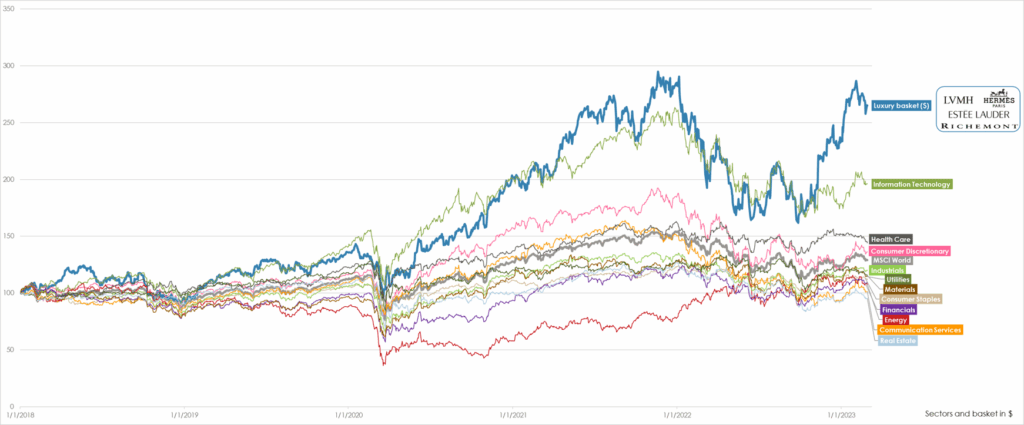
Chart of the Month – Emerging markets’ affinity for luxury: a growing trend

Chart of the Month – Emerging markets’ affinity for luxury: a growing trend

Are you currently considering investment opportunities in emerging markets, all while maintaining a strong presence in assets listed on both European and American markets?

Luxury might just be the ideal solution.

While the luxury sector began the year on a strong note, it has faced challenges in the past two months. Luxury equities saw a decline in August and September, attributed to various factors such as increasing interest rates, disappointing economic data from China including renewed concerns about the real estate market potentially affecting consumer demand and shifts in analyst recommendations. These elements have introduced uncertainty regarding these growth assets.

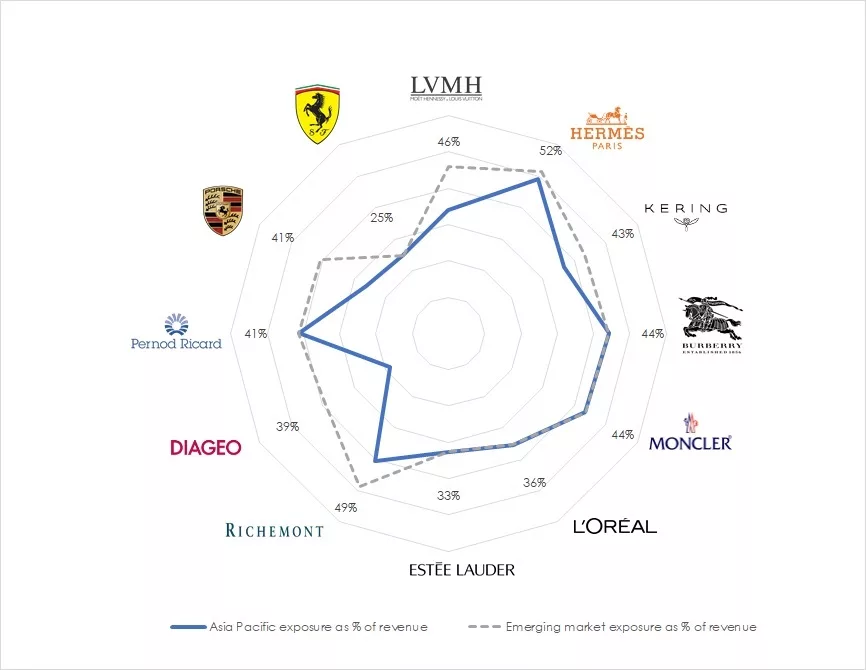
Nevertheless, the financial results reported during the first half of the year provide an encouraging outlook and underline the resilience of this thematic investment. Many of the leading luxury groups are predominantly listed on European and American markets. However, it is essential to assess the extent to which their revenue is derived from emerging markets. A global estimate is therefore essential.

When focusing on the most prominent and distinguished luxury brands, such as LVMH, Hermès, Kering, Moncler, and Burberry in the realm of soft luxury category, Estée Lauder and L’Oréal in the beauty and cosmetics, Compagnie Financière Richemont for hard luxury, Diageo and Pernod Ricard for spirits, and Porsche and Ferrari for automobiles, it becomes evident that the Asia-Pacific region, predominantly represented by China, plays a significant role. This region accounts for over 25% of first-half 2023 revenue. Notably, Hermès leads the pack with a substantial 49% contribution, followed closely by Burberry and Moncler at 44%. Similarly, for Compagnie Financière Richemont and Pernod Ricard the dynamic market contributes 41%. Should we broaden our perspective to encompass other emerging regions, such as for example Latin America and Africa, we find that major luxury groups maintain exposure levels exceeding 35% to emerging countries.

Why are emerging countries catalysts? The luxury sector is buoyed by consumption, increasingly driven by the expanding middle class. Emerging countries are experiencing notable economic growth, with China leading the way and poised to maintain its position at the forefront. Asian consumers aspire to showcase symbols of success and embrace cosmopolitan lifestyles. This year, however, China experienced a slowdown in growth, recovering more slowly than expected. Nevertheless, by 2030, it is predicted that the Chinese, in their own country, will be the largest consumers of luxury goods, according to the renowned firm Bain and Company.

Another rapidly growing economy making headlines is India which is re-entering the global economic spotlight on several fronts. Although luxury consumption in India is currently relatively low, it is showing substantial growth, with a remarkable 26% year-over-year increase. Millennials are the driving force behind the flourishing luxury industry, as India boasts the largest share of millennial consumers among major international economies, exceeding 30%. This demographic profile, combined with rapidly rising urban household incomes, is fueling the swift growth of luxury consumption in India. The Indian economy appears to be on a robust growth trajectory, with one of the fastest GDP growth rates among major world economies.

Investing in emerging markets through well-established and well-managed European and American companies is a prudent strategy. The luxury sector has demonstrated resilience and is considered an all-weather investment. In many cases, the Price/Earnings ratio (P/E) for these companies has returned to pre-COVID levels. Historically, buying luxury company stocks during market corrections has proven to be a profitable investment strategy.


Past performance is not indicative of future results. The views, strategies and financial instruments described in this document may not be suitable for all investors. Opinions expressed are current opinions as of date(s) appearing in this material only. References to market or composite indices, benchmarks or other measures of relative market performance over a specified period of time are provided for your information only. NS Partners provides no warranty and makes no representation of any kind whatsoever regarding the accuracy and completeness of any data, including financial market data, quotes, research notes or other financial instrument referred to in this document. This document does not constitute an offer or solicitation to any person in any jurisdiction in which such offer or solicitation is not authorized or to any person to whom it would be unlawful to make such offer or solicitation. Any reference in this document to specific securities and issuers are for illustrative purposes only, and should not be interpreted as recommendations to purchase or sell those securities. References in this document to investment funds that have not been registered with the FINMA cannot be distributed in or from Switzerland except to certain categories of eligible investors. Some of the entities of the NS Partners Group or its clients may hold a position in the financial instruments of any issuer discussed herein, or act as advisor to any such issuer.  Additional information is available on request.
© NS Partners Group

SMI companies stand out for their ESG commitment

SMI companies stand out for their ESG commitment

The SMI has been awarded the highest rating of AAA by MSCI ESG Ratings. The 20 components of the index have ratings ranging from A to AAA.

Investors are paying increasing attention to environmental, social and governance (ESG) criteria when making investment decisions. They are also motivated by the various regulations in force and pressing issues such as climate change. For their part, companies now recognise the fundamental importance of sustainability and issue reports to demonstrate their commitment to it.

WHAT IS THE SITUATION IN SWITZERLAND?
Switzerland is fully committed to the Paris Agreement, whose central objective is to limit global warming to less than 2°C above pre-industrial levels, with the aspiration of limiting the increase to 1.5°C. Our country is determined to reduce its greenhouse gas emissions, while strengthening its resilience to the consequences of climate change. Switzerland’s ambition is to achieve carbon neutrality by 2050. Switzerland’s main source of renewable energy is hydropower, which is favoured by its mountainous terrain and the presence of numerous rivers. In fact, in 2022, 53% of our total electricity production will come from hydropower. This makes a significant contribution to the production of electricity without greenhouse gas emissions. However, the growth of this source is now reaching a limit, prompting Switzerland to promote the use of other forms of renewable energy such as solar and wind power, which are constantly expanding.

INTEGRATION OF ESG CRITERIA BY SWISS COMPANIES
Sustainability and corporate social responsibility issues are increasingly important in the governance of SMI (Swiss Market Index) companies, which are encouraged to adopt sustainable business practices. At the same time, Switzerland generally enjoys an excellent reputation for corporate governance.

The integration of ESG criteria is therefore becoming increasingly important in Switzerland. Companies are increasingly recognising the importance of disclosing ESG data, not only to meet investor expectations, but also to ensure sustainable and responsible management.

Looking at the 20 largest companies on the SMI, the flagships of the stock market, it is notable that each of them provides a detailed sustainability report, either as part of their annual report or independently. These companies have set targets, particularly for carbon neutrality, with deadlines ranging from 2025 to 2050. In addition, most of them are committed to the 17 United Nations Sustainable Development Goals (SDGs) and have signed up to the 10 Principles of the UN Global Compact, which encourages companies to adopt responsible and sustainable business practices.

The approach to sustainability is transparent and proprietary within these companies, with a focus on gender equality and reducing their environmental impact.

ESG ASSESSMENT OF SWISS COMPANIES
The composition of the SMI gives it a rating of AAA, the highest according to MSCI ESG Ratings. The 20 components of the index have ratings ranging from A to AAA, putting the index at the top of the MSCI universe. Most of these companies are leaders in terms of ESG criteria in their respective industries. As for carbon emissions, these depend on the sector, with Holcim and Nestlé the biggest emitters, and Sonova and Partners Group the smallest. For the vast majority of SMI companies, there has also been a significant improvement in governance or solidity. If we broaden our analysis to include criteria such as controversies, recent developments and the ability to rank in the top quartile of their industry in terms of the three pillars E, S and G, we can see that Novartis, Givaudan, Kuehne + Nagel and Zurich Insurance seem to stand out in particular.

We can therefore conclude that the Swiss companies in the SMI stand out for their remarkable commitment to sustainability and corporate social responsibility. This approach reinforces Switzerland’s reputation as an investment destination of choice. Over the last 5 years, the SMI has outperformed the global market (MSCI World Index in CHF) by 543 basis points.


Past performance is not indicative of future results. The views, strategies and financial instruments described in this document may not be suitable for all investors. Opinions expressed are current opinions as of the date(s) appearing in this material only. References to market or composite indices, benchmarks or other measures of relative market performance over a specified period of time are provided for your information only. NS Partners provides no warranty and makes no representation of any kind whatsoever regarding the accuracy and completeness of any data, including financial market data, quotes, research notes or other financial instruments referred to in this document. This document does not constitute an offer or solicitation to any person in any jurisdiction in which such offer or solicitation is not authorized or to any person to whom it would be unlawful to make such offer or solicitation. Any reference in this document to specific securities and issuers are for illustrative purposes only, and should not be interpreted as recommendations to purchase or sell those securities. References in this document to investment funds that have not been registered with the Finma cannot be distributed in or from Switzerland except to certain categories of eligible investors. Some of the entities of the NS Partners group or its clients may hold a position in the financial instruments of any issuer discussed herein, or act as advisor to any such issuer. Additional information is available on request.

© NS Partners Group

Chart of the Month – A luxury everyone should afford

A luxury everyone should afford

Looking for a long-term investment that can withstand the economic turmoil? Well, consider luxury!

Marketwise, a year never resembles the previous one. The last five years have been subject to many headwinds: Covid-19, Ukraine-Russia conflict, rising interest rates, inflation, etc. Finding a sector, an investment that resists and performs during these different and multiple periods of shocks is difficult.

Luxury might be a good candidate. We like this sector for its all-terrain characteristics, its resilience and adaptability.

On the European market, luxury is gradually establishing itself as a major sector and is gaining in importance. It now represents 19% of the French CAC40 index and LVMH has become the largest European company with a market capitalization of EUR396 billion at the end of February. Luxury got off to a flying start in January, riding on the current optimism on China. Indeed, the Chinese Economy showed a strong rebound which bodes well for luxury stocks. China’s manufacturing purchasing managers’ index rose to its highest level since April 2012.

The luxury sector is vast and its definitions are multiple, which adds a layer of complexity and confusion. This is why one must remain selective and focus on the major luxury players that sailed on headwinds. We no longer need to demonstrate the quality of their balance sheets, their ability to report higher results and double-digit margins year after year and their success in offsetting one region with another. Their scale brings them access to the best designers and increasingly to celebrities.

For example, let’s have a look at an equally weighted portfolio composed of 4 large and well-known listed luxury companies. First component, LVMH the most diversified group active in soft luxury (clothes, shoes, leather goods, etc.), hard luxury (watches and jewellery), perfumes and cosmetics, wines, hotels, and more, then Hermès, active in soft luxury, Cie Financière Richemont in hard luxury, and finally Estée Lauder in cosmetics and beauty, the latter being more defensive by nature. The dollar-based basket composed of these 4 equally weighted stocks has outperformed the MSCI World, as well as the 11 Global Industry Classification Standard (GICS) sectors over the last 5 years.

Most luxury stock prices are at all-time high. What about the future? Today the valuation multiples are high but appear reasonable, as the estimated Return on Equity and Earning per share are higher for the luxury basket presented than for any sectors. Its fundamentals remain sound and intact, as China brings some good hope. Additionally, one should keep in mind that inflation is still present and that luxury companies have strong pricing power, as demand for luxury goods is fairly inelastic to price. This means that they can protect their margins. But what would happen to the luxury sector in times of recession? The sector’s consumer base is wider spread and less sensitive to economic slowdown than most and it benefits from a simultaneously defensive and growth profile. In other words, the sector is able to grow profits whatever the economy throws at it. In order to capture the right moment, one entry signal to watch closely is the luxury premium. After shooting up, the premium has fallen back to historical levels, so now could be a good buying opportunity.

It is quite impossible to predict the coming year, but one thing is certain: investing in luxury and adding on/doubling down on this investment on eventual corrections seems to be an interesting strategy.

“Luxury will be always around, no matter what happens in the world”. Carolina Herrera


Past performance is not indicative of future results. The views, strategies and financial instruments described in this document may not be suitable for all investors. Opinions expressed are current opinions as of date(s) appearing in this material only. References to market or composite indices, benchmarks or other measures of relative market performance over a specified period of time are provided for your information only. NS Partners provides no warranty and makes no representation of any kind whatsoever regarding the accuracy and completeness of any data, including financial market data, quotes, research notes or other financial instrument referred to in this document. This document does not constitute an offer or solicitation to any person in any jurisdiction in which such offer or solicitation is not authorized or to any person to whom it would be unlawful to make such offer or solicitation. Any reference in this document to specific securities and issuers are for illustrative purposes only, and should not be interpreted as recommendations to purchase or sell those securities. References in this document to investment funds that have not been registered with the FINMA cannot be distributed in or from Switzerland except to certain categories of eligible investors. Some of the entities of the NS Partners Group or its clients may hold a position in the financial instruments of any issuer discussed herein, or act as advisor to any such issuer.  Additional information is available on request.
© NS Partners Group

Luxury: diversity and all-terrain performance

Luxury: diversity and all-terrain performance

Why not invest in luxury? The sector has proved its resilience and adaptability.

Like other industries, luxury was hit hard in 2020 by lockdowns and the abrupt stop of international travel. After bouncing back in 2021, luxury stocks ended 2022 in the red. This negative year, however, gave investors some good opportunities. The big luxury groups saw their valuations first rocket then settle back. Multiples now look high but remain reasonable.

Luxury a big winner from China’s reopening

Luxury got off to a flying start this year, riding the surge of optimism on China, a big driver for the sector. Sales had actually grown strongly in the United States and Europe last year, despite China being locked down due to its zero-Covid policy. China’s reopening and the return of domestic and international flights now point to a catch-up surge and, for the luxury sector, a year of rising sales and revenue.

Luxury premium back down despite its 5-year outperformance

The last five years have included plenty of headwinds: Covid-19, the war in Ukraine, rising interest rates, inflation, etc. Despite this, over the last 5 years Hermès, LVMH and Ferrari stocks have gained +223%, +177% and +129%, respectively. The same goes for earnings per share, up +155% at Hermès and LVMH and +80% at Ferrari. Over the same period, luxury as a sector outperformed the market by +15.8%. Of course, some sub-sectors were impacted, particularly travel and hospitality which are heavily correlated with tourism.

Luxury stocks traditionally trade at a premium to the market. What happens to this premium can be used as an entry signal. And, after shooting up, it has fallen back to attractive historical lows.

Diverse geographies and consumers

Investing in luxury means investing in a sector sheltered by high entry barriers, in companies with sound and healthy balance sheets, growing revenue and usually double-digit margins. Less obviously, it also gives you exposure to emerging markets. Hermès, Kering, Burberry, Salvatore Ferragamo, Compagnie Financière Richemont and Swatch, for instance, make between 38% and 47% of their revenue in Asia.

Until recently, most of the shopping by this clientele was done while travelling abroad. To expand local consumption in China, the luxury majors built up local exposure, opening multiple stores and creating websites to target these markets. China’s reviving consumption is therefore good news, particularly as Chinese consumers have built up billions of yuan in unspent savings over the last three years.

Luxury can cope with anything

Inflation is still a factor. However, companies in the luxury sector command strong pricing power as demand for luxury goods is fairly inelastic to price. This means they can protect their margins. But what happens to the luxury sector in times of recession? The sector’s consumer base is wider spread and less sensitive to economic slowdown than most and it benefits from a simultaneously defensive and growth profile. Luxury houses are cash rich and free to make acquisitions. Groups are diversifying, led by the biggest of them all LVMH, which is active in soft luxury (clothes, shoes, leather goods, etc.), watches and jewellery, perfumes and cosmetics, wines, hotels, and more. This year, Kering said it was creating a strategic division to break into the beauty sector. Thanks to a huge and expanding consumer base, the sector has room to grow 60% by 2030, according to consultants Bain & Company. Generation Z is in the front line. Gen Z-ers are demanding and buy their first luxury goods at around 15, 3-5 years younger than their Millennial predecessors. Generation Z and the upcoming Generation “Alpha” (younger but with similar consumption patterns) should make up around a third of the luxury market by 2030. In response, luxury is adapting, digitising and expanding its footprint on social media and in the metaverse.  It is also embracing environmental and social issues, prioritising transparency in processes, supply lines and management of second-hand goods.

So the constantly evolving luxury sector is doing rather well and its fundamentals remain sound and intact. It remains resilient and able to grow profits whatever the economy throws at it.


Past performance is not indicative of future results. The views, strategies and financial instruments described in this document may not be suitable for all investors. Opinions expressed are current opinions as of the date(s) appearing in this material only. References to market or composite indices, benchmarks or other measures of relative market performance over a specified period of time are provided for your information only. NS Partners provides no warranty and makes no representation of any kind whatsoever regarding the accuracy and completeness of any data, including financial market data, quotes, research notes or other financial instruments referred to in this document. This document does not constitute an offer or solicitation to any person in any jurisdiction in which such offer or solicitation is not authorized or to any person to whom it would be unlawful to make such offer or solicitation. Any reference in this document to specific securities and issuers are for illustrative purposes only, and should not be interpreted as recommendations to purchase or sell those securities. References in this document to investment funds that have not been registered with the Finma cannot be distributed in or from Switzerland except to certain categories of eligible investors. Some of the entities of the NS Partners group or its clients may hold a position in the financial instruments of any issuer discussed herein, or act as advisor to any such issuer. Additional information is available on request.

© NS Partners Group

NS Impact – Notre engagement 2023

Un engagement concret pour la collectivité

Nous sommes convaincus que les énergies individuelles ont bien plus d’impact lorsqu’elles sont fédérées au sein d’un projet collectif.
C’est pourquoi, avec l’ensemble des collaborateurs de NS Partners, nous choisissons chaque année les projets qui seront soutenus.

Et chaque fois que cela est possible, notre engagement va plus loin que le simple soutien financier pour se traduire dans un véritable engagement personnel et une participation active.

Voici les projets soutenus pour cette année 2023:

  • Refettorio Geneva: notre donation se traduira par le parrainage d’une table du restaurant. De plus, nos collaborateurs s’engageront ponctuellement lors de services du soir.
  • Association Zoé4life: nous offrirons les perles d’encouragement Kanji, colliers des héros. De plus, nous constituerons une cagnotte pour le projet All4life, qui améliore la qualité de vie des enfants, adolescents et jeunes adultes guéris d’un cancer pédiatrique.
  • Les Petits Frères des Pauvres – Jamais seul-e: nous soutiendrons financièrement le renouvellement du site internet et des nouveaux flyers. Nous participerons également à la journée Portes Ouvertes.

Découvrez ici les associations et les projets en détails.

NSImpact