
China Narrows The AI Capability Gap

CHINA NARROWS THE AI CAPABILITY GAP

China's AI capabilities improving over time


This month’s chart illustrates one of the most significant developments in the global technology landscape: the rapid rise of China’s frontier AI capabilities and the narrowing performance gap with the United States. The graph tracks the top-performing AI model from each country between mid 2023 and late 2025. While the United States maintains a slight lead throughout the period, the visual trend is unmistakable: China is accelerating quickly, with breakthrough moments that reshape expectations about global AI competition.


The most dramatic shift occurs in early 2025 with the release of DeepSeek R1, highlighted in the chart. This model marks a turning point not only in China’s domestic AI progress but also in the broader perception of what Chinese companies can achieve under resource constraints. According to the European Union Institute for Security Studies, DeepSeek R1 demonstrated performance on par with leading American models while using far less computing power and dramatically lower training costs, challenging the assumption that semiconductor export restrictions would slow China’s progress. This breakthrough signals a structural shift: algorithmic efficiency and model design have become strategic strengths within China’s AI ecosystem.


Stanford University’s 2025 AI Index report supports the trend displayed in the graph, noting that China has significantly closed the performance gap with the United States, even though the U.S. continues to produce more frontier models overall. Chinese models such as DeepSeek R1 now rank very close to top U.S. systems on independent benchmarks including LMSYS. The chart reflects this convergence clearly, as the red line representing China rises sharply from 2023 onward, narrowing the distance with the U.S. trajectory.


DeepSeek R1’s impact also stems from its unprecedented efficiency. Reports indicate that the model was trained for approximately $6 million, far below the estimated $100 million-plus investment required for models like OpenAI’s GPT-4. This efficiency not only enabled rapid iteration but also disrupted global markets, with U.S. technology stocks experiencing significant volatility following the model’s release. The economic effects reinforce what the chart shows technologically: China is no longer simply following developments in AI but increasingly shaping the competitive landscape.


Beyond individual models, China’s broader AI ecosystem has strengthened in ways that help explain the steep upward trajectory seen in the graph. Chinese companies have embraced open-source development, improving adoption and accelerating innovation cycles. They have also benefited from strong government support, growing domestic talent pipelines, and an expanding volume of high-quality research output. According to Recorded Future’s 2025 analysis, Chinese generative AI models now trail U.S. counterparts by only three to six months, a remarkably small window given earlier expectations and one that aligns directly with the chart’s near convergence by late 2025.


Overall, the chart captures a moment of profound technological shift. While the United States retains a narrow lead in frontier AI models, China’s rapid progress—driven by efficiency, innovation, and strategic investment—has brought the two countries closer than at any previous point. The upward movement of China’s capability line is not just steep; it is indicative of a maturing ecosystem capable of producing globally competitive models despite resource constraints and external pressures. As the pace of development continues, the global AI landscape in 2026 and beyond is likely to be more multipolar, more competitive, and more dynamic than ever before.


Written by Gabriele Casati


Past performance is not indicative of future results. The views, strategies and financial instruments described in this document may not be suitable for all investors. Opinions expressed are current opinions as of date(s) appearing in this material only. References to market or composite indices, benchmarks or other measures of relative market performance over a specified period of time are provided for your information only. NS Partners provides no warranty and makes no representation of any kind whatsoever regarding the accuracy and completeness of any data, including financial market data, quotes, research notes or other financial instrument referred to in this document. This document does not constitute an offer or solicitation to any person in any jurisdiction in which such offer or solicitation is not authorized or to any person to whom it would be unlawful to make such offer or solicitation. Any reference in this document to specific securities and issuers are for illustrative purposes only, and should not be interpreted as recommendations to purchase or sell those securities. References in this document to investment funds that have not been registered with the FINMA cannot be distributed in or from Switzerland except to certain categories of eligible investors. Some of the entities of the NS Partners Group or its clients may hold a position in the financial instruments of any issuer discussed herein, or act as advisor to any such issuer.  Additional information is available on request.
© NS Partners Group

China’s growth 2025: The dragon awakens

Hedge funds are betting on AI, tech and local consumption to tap into China’s renewed growth.

A renewed sense of optimism among fund managers

Is 2025 finally the turning point for Chinese markets? After several years of painful adjustments, positive signals are starting to align. In Hong Kong, hedge fund managers are becoming increasingly constructive. During a recent trip to Asia, we met with over thirty managers focused on Chinese markets and they all shared a similar view: both top-down and bottom-up conditions are improving.

Strong earnings rebound in Chinese companies

What’s driving this shift? A clear policy pivot from Beijing in September 2024 marked the start of stronger support for the economy and markets. The result: a robust earnings rebound in Q1 2025. BYD reported a 98% increase in EPS, SMIC posted +162% growth in net income and Xiaomi +64%. In a market where corporate earnings serve as a proxy for the macro picture, these numbers speak volumes.

Domestic consumption remains a key challenge

The key domestic driver remains consumption, still below its pre-COVID potential. The government is trying to boost demand with widespread discounts, reaching up to 20% on certain goods. Yet, with employment still under pressure, a sustained rebound in consumption will be hard to achieve without a recovery in the job market.

Real estate: confidence returns, slowly

The real estate sector, long the epicenter of the crisis, appears to have bottomed out. In cities like Shanghai, some new developments are seeing price increases of up to 10%. Some funds are taking this opportunity to re-enter the space via property management companies, seen as more resilient and better positioned to benefit from China’s new housing quality standards.

Sector rotation toward the domestic market

In response to this changing landscape, portfolios are shifting. The dominant trend is clear: a gradual exit from export-driven names and a renewed focus on domestic demand beneficiaries. Consumption, technology (particularly TMT), industrials and AI are leading this sector rotation.

AI in China: ambition, capital, and sovereignty

China’s technological acceleration is striking. AI has become a strategic national priority. Alibaba announced a USD 53 billion investment in AI and cloud and Tencent is following a similar path. The push for tech sovereignty is also visible in the semiconductor sector, where managers are identifying opportunities across the value chain, from chipmakers to materials and equipment providers.

Tech and EVs at the forefront

Digital giants like JD.com, Pinduoduo and Meituan remain core holdings, benefiting from China’s market depth, rapid digitalization and the government’s renewed support for private platforms. The EV sector, driven by players like BYD, NIO and Xiaomi, is thriving at the intersection of China’s climate goals and rising consumer appetite for premium products.

Hedge Funds adapting to volatility

Lastly, Hong Kong-based hedge funds are increasingly using derivatives to manage exposure and volatility. After diversifying into other Asian markets and the US, many are now reallocating substantially back into China. The underlying belief: despite ongoing uncertainties, China’s fundamentals are once again turning attractive.


Past performance is not indicative of future results. The views, strategies and financial instruments described in this document may not be suitable for all investors. Opinions expressed are current opinions as of the date(s) appearing in this material only. References to market or composite indices, benchmarks or other measures of relative market performance over a specified period of time are provided for your information only. NS Partners provides no warranty and makes no representation of any kind whatsoever regarding the accuracy and completeness of any data, including financial market data, quotes, research notes or other financial instruments referred to in this document. This document does not constitute an offer or solicitation to any person in any jurisdiction in which such offer or solicitation is not authorized or to any person to whom it would be unlawful to make such offer or solicitation. Any reference in this document to specific securities and issuers are for illustrative purposes only, and should not be interpreted as recommendations to purchase or sell those securities. References in this document to investment funds that have not been registered with the Finma cannot be distributed in or from Switzerland except to certain categories of eligible investors. Some of the entities of the NS Partners group or its clients may hold a position in the financial instruments of any issuer discussed herein, or act as advisor to any such issuer. Additional information is available on request.  © NS Partners Group
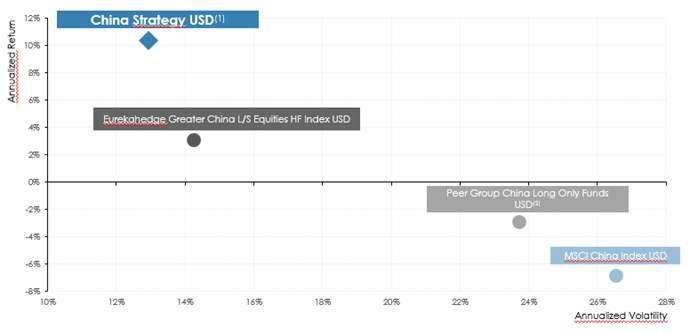
Chart of the month: Asia, the alpha opportunity

Asia: the alpha opportunity


Source: Morgan Stanley Fund Services, MSCI


Since the onset of COVID-19, dispersion in the US and Asia has significantly increased, with Asia continuing to show higher levels. This accounts for the superior performance of Long/Short strategies in recent years, especially in Asia, where there are more opportunities to go long on high performers and short underperformers, allowing these strategies materialize in stock returns.

Over the past decade, Asia’s expanding market size, liquidity, and sector depth have led to a greater diversity in returns, providing an often-overlooked source of alpha opportunities. Many stocks remain under-researched or misunderstood due to local barriers such as language, culture, and regulations. Historically, Asia was seen as a growth market, with cyclical foreign investor flows mainly chasing market beta. However, Asian markets are now evolving into a diverse investment landscape, where fundamental stock selection is becoming increasingly rewarding.

The return composition of Asian equities is becoming more alpha-driven, with stock selection playing an increasing critical role. This is essential in an environment where performance bifurcation within industries has become more pronounced. Following a period of systematic beta decline, markets are now finding strong support levels. Concurrently, improved policy clarity and stability in the economy are boosting confidence in stock selection, allowing investors to focus more on fundamentals rather than tail-end events.

Our strategy: the equity Long/Short multi-manager approach offers the right diversification for investors looking to reallocate capital to the region. Managers have been performing well this year. Since we began investing in the region, we’ve had the opportunity to allocate capital to managers who have successfully protected capital during downturns while generating strong returns in rising markets, benefiting from good asymmetric returns.

The regional market structure is shifting from beta-driven to alpha-driven opportunities. To capitalize on this, we must quickly adapt to the new investment environment with an agile approach. Managers using a Variable Net hedge fund approach provide the necessary flexibility. Overall, we favor active investments over passive ones. Passive investments, such as ETFs, fail to capture the new economic trends, while active long-only funds are less dynamic in adjusting exposure to the right sectors to seize market opportunities.


Past performance is not indicative of future results. The views, strategies and financial instruments described in this document may not be suitable for all investors. Opinions expressed are current opinions as of date(s) appearing in this material only. References to market or composite indices, benchmarks or other measures of relative market performance over a specified period of time are provided for your information only. NS Partners provides no warranty and makes no representation of any kind whatsoever regarding the accuracy and completeness of any data, including financial market data, quotes, research notes or other financial instrument referred to in this document. This document does not constitute an offer or solicitation to any person in any jurisdiction in which such offer or solicitation is not authorized or to any person to whom it would be unlawful to make such offer or solicitation. Any reference in this document to specific securities and issuers are for illustrative purposes only, and should not be interpreted as recommendations to purchase or sell those securities. References in this document to investment funds that have not been registered with the FINMA cannot be distributed in or from Switzerland except to certain categories of eligible investors. Some of the entities of the NS Partners Group or its clients may hold a position in the financial instruments of any issuer discussed herein, or act as advisor to any such issuer.  Additional information is available on request.
© NS Partners Group
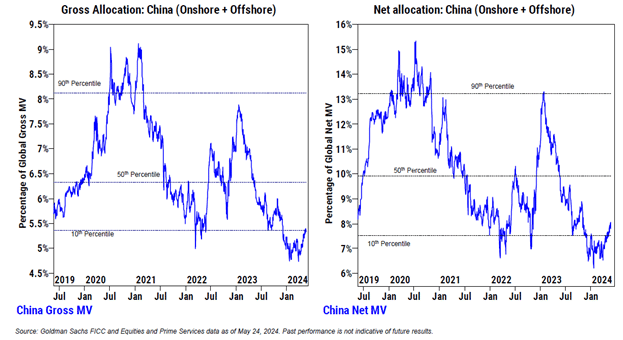
Chart of the Month – China: an interesting risk/return profile to be exposed to the region.

China: an interesting risk/return profile to be exposed to the region.

 
Source: NS Partners, Bloomberg. Data as of 30 April 2024. Performance in USD. Risk statistics against the MSCI China Index USD calculated on a monthly basis, with a risk-free rate of 1.0%.
(1) China B USD = Haussmann China/Asia Equity Long/Short allocation (K USD Share Class, with 1.40% management fees) from 31 December 2017 to 31 March 2021. From 1 April 2021 real track record of Mahjong China Fund B USD, net of fees. (2) Peer Group = long only China equity funds discretionary selected by NS Partners (10 funds), equally-weighted and rebalanced on a monthly basis. This slide includes historic returns and past performance is not a reliable indicator of future results. The value of investments can go down as well as up.

After 3 years of bear market in China, I see structural alpha opportunities emerging this year and managers are starting to gradually re-allocate capital in the region.

TMT stocks are the most net bought this year, information technology is the most overweight sector in this region. The financial sector remains the most underweight sector in the region, it has seen net inflows YTD but is among the most underweight ones in China.

Chinese equities continue to see slow but steady buying, with net buying flows. H shares have led the recent inflows followed by ADRs. A-shares continue to be net sold. But the most important Gross and Net allocation is gradually increasing.

Our strategy: China equity L/S multi-managers strategy can give the right diversification to investors that are willing to re-allocate capital to the region.

Managers are generating good performance so far this year. Since we started investing in the region, we had the ability to allocate capital with managers that were able to protect the capital in the down market and to generate good results in up market given good asymmetric returns.

The market in the region is structurally changed, moving from beta to alpha opportunities, thus we need to adopt rapidly to new investments regime and we need to be nimble in our approach; managers using Variable Net hedge fund approach can give the right flexibility. Overall, we prefer active investment over passive ones. Passive investments (ETFs) don’t follow the new trends that the economy is generating and active long only funds are less dynamic to move the exposure to the right sectors to capture market opportunities.

The return composition of the Chinese equities market is becoming more Alpha dominant. Stock selection has become a key driver in an environment where bifurcation of stock performance within an industry is a more common occurrence and it has also happed on a greater magnitude. After a period of systematic beta downtrend, markets are settling at a level of relatively strong support. At the same time, further clarity and stability across the economy and policy direction improve conviction level on stock selection, allowing investors to shift focus away from tail-end events and back into fundamentals.

China’s economy pivoted from export-manufacturing driven during 2000-2010, to domestic-consumption driven in 2010-20. It started another major rebalancing 2-3 years ago, amid the geopolitical tensions and its demographic challenges, to focus on self-reliance and advanced manufacturing.

Building a portfolio of local hedge fund managers adopting different strategies is the right approach to generate good risk-return performance. The universe of managers in China is big, there are hundreds of funds, manager selections is a key component.

The last 3 years was a big stress test for the managers, market experienced one of the worst drawdowns in history and I’m really convinced that from this period of bear market that big opportunities can emerge.


Past performance is not indicative of future results. The views, strategies and financial instruments described in this document may not be suitable for all investors. Opinions expressed are current opinions as of date(s) appearing in this material only. References to market or composite indices, benchmarks or other measures of relative market performance over a specified period of time are provided for your information only. NS Partners provides no warranty and makes no representation of any kind whatsoever regarding the accuracy and completeness of any data, including financial market data, quotes, research notes or other financial instrument referred to in this document. This document does not constitute an offer or solicitation to any person in any jurisdiction in which such offer or solicitation is not authorized or to any person to whom it would be unlawful to make such offer or solicitation. Any reference in this document to specific securities and issuers are for illustrative purposes only, and should not be interpreted as recommendations to purchase or sell those securities. References in this document to investment funds that have not been registered with the FINMA cannot be distributed in or from Switzerland except to certain categories of eligible investors. Some of the entities of the NS Partners Group or its clients may hold a position in the financial instruments of any issuer discussed herein, or act as advisor to any such issuer.  Additional information is available on request.
© NS Partners Group