
Chart of the month: From Pod-Shop to Quant-Shop – The new El Dorado?

From Pod-Shop to Quant-Shop – The new El Dorado?

From pod-shop to quant-shop - the new El DOrado? Source: NS Partners, Bloomberg

Most of our readers will be familiar with the numerous pieces we have written over the last five years on the pod-shop model which have made both investors and investment managers very happy over the last two decades, with their performance culminating in 2024, one of the best years in recent history besides 2020 (read our piece back in January of this year: Peak Pod Shop – Where to Next?). Fast forward to today and performance in 2025 so far has proved to be challenging for most of them given the current risk-free rate. The Good, the Bad and the Ugly side of the pod-shop model has been increasingly highlighted by the press in recent months and pension funds amongst others are starting to shy away from this model as most still focus on total expense ratios (despite the superior risk adjusted returns of the past). Egregious fees (via the infamous passthrough model), poaching games on star traders (via creative enticement programs), the higher cost of leverage, significant market share of the overall hedge fund industry (and even more so in terms of global market footprint and impact when you include their leverage) and correlation between them are some of the common criticisms. YTD it is fair to say that most pod shops have disappointed investors (particularly in the market neutral US equity long / short space) in a market that has witnessed lots of turmoil during the first quarter and have barely recovered since then. Add to that the reluctance in applying a risk-free rate hurdle to performance fees charged and you will have a backlash on pod-shops that don’t deliver. The subsequent problem with that is where does one redeploy such large amounts of money despite the quarterly investor level gates that are increasingly being raised as assets balloon.

Since the “Quant Winter” between 2018 and 2020, quant funds have been performing with consistency, which has not gone unnoticed. As a result, they have been very successful in significantly raising assets this year, propelling some of the largest quant shops to the top of the Global Billion Dollar Club. They offer lower expense ratios (unlike the high passthrough structures for hiring talented traders), better liquidity (with no investor level gate for the most part), AND the client does not take the netting risk. From fundamental, technical, flow and sentiment driven signals, quant funds come in different garden varieties, and they all work until they don’t, and you never know when or why until after the event. One must not forget August 2007, which was a memorable moment for quant funds where the last one standing in the game of musical chairs was the winner-take-all! We did witness somewhat of a repeat this July, although with less drama (mostly due to short squeezes and factor rotations) but overall, they have demonstrated consistency in outperforming traditional pod shops.

Quantitative strategies take out the emotional factor in investment decisions (more rational and consistent decision making) however there are certain instances where quant shops can get blindsided by unpredictable events. “Liberation Day” was the latest example where many were caught off guard. Quant shops typically do not fare well during macro or geopolitical events. Sentiment is also another important factor to which many have had to adopt. Over the last five years quant shops have been increasing the use of AI and LLMs at an exponential rate and now seeking new ways in achieving machine “superintelligence”. Add to that the increasing availability of a plethora of new data sets and you have models that have become increasingly sophisticated and hard to compete with. The main drawback remains the fact that these models cannot plan for unexpected events or reasons like human beings. Perhaps the combination of quant strategies with a discretionary overlay or vice versa is the optimal solution going forward. DE Shaw, one of the oldest quant shops, just launched its first new multi-strategy fund in 15 years which will be running discretionary strategies instead of the algorithms they are historically known for. This trend is likely to continue.

With the average holding period for US stocks having declined significantly from over 5 years back in the 1970s to less than a few months today, this trend has somewhat been amplified by the pod-shops given the strict drawdown limits imposed on their PMs who typically trade over a quarter trying the anticipate the next earnings miss or beat. Quant shops have an even shorter time horizon ranging from nanoseconds (in the case of co-location) to 20 days or more and have thus further increased this trend. Gone are the traditional hedge funds that buy and hold over a long-time horizon whilst stomaching short term volatility. Perhaps this is one of the reasons why the daily trading volumes on the NYSE have consistently been beating records which have been approaching 5 trillion shares in a single day! Fair to say that today what you see on publicly available data is only the tip of the iceberg as most of the very large (and levered pod/quant shops) have their own internal liquidity provision whereby up to a third of their trades are matched internally therefore avoiding transaction costs and thus don’t appear in the official data. At the end of the day, it is a balance sheet exercise where both pod shop and quant shops manage thousands of underlying positions with a lot of leverage centered around a select number of prime brokers if not one (to offset trades internally when they can).

Whilst it is hard to gauge the total market share of the global hedge fund industry represented by pod shops and quant funds today (from the 25-30% of total AUM in 2024), one thing for sure is that given the leverage involved, the risk of getting run over remains very high given the recent growth in the quant space.

Past performance is not indicative of future results. The views, strategies and financial instruments described in this document may not be suitable for all investors. Opinions expressed are current opinions as of date(s) appearing in this material only. References to market or composite indices, benchmarks or other measures of relative market performance over a specified period of time are provided for your information only. NS Partners provides no warranty and makes no representation of any kind whatsoever regarding the accuracy and completeness of any data, including financial market data, quotes, research notes or other financial instrument referred to in this document. This document does not constitute an offer or solicitation to any person in any jurisdiction in which such offer or solicitation is not authorized or to any person to whom it would be unlawful to make such offer or solicitation. Any reference in this document to specific securities and issuers are for illustrative purposes only, and should not be interpreted as recommendations to purchase or sell those securities. References in this document to investment funds that have not been registered with the FINMA cannot be distributed in or from Switzerland except to certain categories of eligible investors. Some of the entities of the NS Partners Group or its clients may hold a position in the financial instruments of any issuer discussed herein, or act as advisor to any such issuer.  Additional information is available on request.
© NS Partners Group
Last one standing – Reconsider European equity long short funds – NS Insights

European equity long short funds have suffered from Europe’s lack of appeal. But now might be the time to reconsider them.

At the beginning of the 2000s, most private banks and asset management firms based in Geneva managed their own funds of funds that invested in a new generation of young alternative managers specialising in European equity long/short strategies. At the time, these multi-manager funds delivered double-digit annualised returns, net of management and performance fees. After starting their careers as equity managers within large traditional investment companies, most of these talents left in the 1990s to establish their own independent asset management firms. Many of them were backed by alternative investment legends such as George Soros and Michael Steinhardt, to run portfolios of long/short equity ideas in Europe, a strategy that had already proven its worth in the United States since the 1950s.

An endangered species?

Today, all European funds of funds specialising in long/short equity have disappeared, with one exception. The main reason: the 2008 global financial crisis wiped out many hedge funds in Europe, partly because they offered more attractive liquidity terms than their American counterparts. Added to this, the US equity market has significantly outperformed Europe since 2009 (thanks to the tech sector), following a similar trend from 1989 to 2009, which further reduced the appeal of European equities. Moreover, Europe has been weakened by geopolitical challenges, making it even less attractive to international investors.

Investors have short memories

Yet it is well known that every crisis also presents significant opportunities for long/short managers. Many have already forgotten the Greek debt crisis at the end of 2009 and, more importantly, the country’s remarkable recovery after the 2018 bailout! This year, Greece ranks among the best-performing equity markets in the world, alongside other so-called peripheral markets like Poland, the Czech Republic, Spain and Italy, while Switzerland has lagged, moving similarly to France since the start of the year.

Make Europe Great Again

Published at the end of 2024, the Draghi report provided European leaders with a roadmap to “make Europe great again” by boosting investment and productivity. The report highlighted the need to invest EUR900 billion annually (around 4.5% of EU GDP) to address the continent’s structural competitiveness gap. This year, Germany announced a EUR500 billion plan over ten years to modernize its infrastructure. More recently, Blackstone unveiled plans to invest USD500 billion in Europe over the next decade. And this is just the tip of the iceberg, with many other initiatives underway across the continent to strengthen its competitiveness.

Europe is home to some of the world’s best companies

While Europe certainly has its share of struggling companies, it is also home to some of the most successful firms globally in luxury, pharmaceuticals, chemicals, energy, defense, and aerospace, all ideal playing fields for long/short strategies. Despite this, the universe of European long/short managers has been shrinking every year since the 2008 financial crisis, due to a lack of interest or liquidity compared to the US. Nevertheless, on a regional basis, managers focused on Europe have been among the top performers since the start of the year.

High potential but hard to access

History shows that the US has long produced some of the best long/short managers. However, over the past five years, some of the brightest talents in this space are found in Europe. They have managed to generate positive alpha on both their long and short positions, while skillfully adjusting their net exposure, an advantage often linked to the smaller size of their funds. Still, the capacity of these strategies remains limited due to low scalability tied to liquidity, restricting access to these opportunities. The best way to tap this potential is to invest in a collective vehicle specialising in Europe, with strong expertise in selecting and monitoring the top European managers. However, access to these funds often remains limited to a select circle, as they are frequently closed to new investors.

Notably, the GRANOLAS (Europe’s equivalent of America’s “Magnificent Seven”) have started to underperform the Stoxx 600 since early April, creating greater dispersion and a more favorable environment for selecting long and short positions. With Europe once again facing geopolitical tensions and the persistent risk of deglobalisation, it might just be time to reconsider European long/short strategies.

Peak pod shop – Where to next?

Peak pod shop – Where to next?

Over the last four years we have published several pieces about multi-manager platforms (commonly referred to as pod shops) highlighting “the good, the bad and the ugly”. In each of the last four years we have witnessed over a dozen new launches, and this year is no exception. They all claim to be in niche strategies that eventually become victims of their success and soon face the inevitable growing pains of scaling up followed by diluted returns as they grow their assets too rapidly. Very few have survived the test of time and remained successful despite their phenomenal growth in assets. One could argue that the largest pod shops today all started with a much smaller base and performed way better in their beginnings.

Reuters recently reported that 38.3% of the entire hedge fund industry’s returns over the past three years were generated by Citadel, Millennium and D.E. Shaw, which represent only 4.6% of the industry’s entire assets under management. As the three have been around for 25 years and each have around $60 bio under management, this is quite a remarkable achievement. Add Point 72 (formerly SAC Capital) to the mix and you have the largest pod-shop juggernauts in the world (Ex DE Shaw) representing 42% of the entire pool of pod shops.

Over the last two years there have been several papers published by various prime brokers about pod shops and they all highlight the fact that the larger the pod shop and the larger the passthrough structure, the better they perform. Hence this month’s chart, which illustrates their average performance in 2023 and the impact of fees (“the ugly”) eating into gross performance. The industry has increasingly been confronted with a never-ending game of musical chairs as the war for acquiring talent continues unabated. As a result, pod shops are getting overly expensive thanks to the pass-through structure and yet clients are happy to pay as they are yet to suffer from significant drawdowns (bar a few exceptions in 2008) single hedge fund managers face at some point in their career. At NS Partners we have obviously benefitted from them, as our low volatility mandate has achieved an annualized return of 5% (net of fees) with a volatility of under 2% over the last 3 years. This is essentially what pension funds needed during a zero-interest rate environment but now that cash yields the same, the bogey has changed. Now the time has arrived for the next evolution of our low volatility mandate which we had initially overhauled back in the summer of 2020.

So where do we go from here as not all pod shops are created equal. Talent is scarce and not scalable which enables the smaller pod shops to generate superior returns (as long as they intend to stay small and hence uninteresting for the large pension funds/endowments). Like single manager hedge funds, size and leverage can become your biggest enemy exposing you to left tail events, especially in a sudden deleveraging environment following a market shock or liquidity event. With a footprint of 30% of US equities in 2023 according to Goldman Sachs, this makes them larger than that of the traditional single manager equity L/S funds. The footprint is even larger in terms of headcount where it is estimated that they account for over a quarter of the industry’s headcount (the 3 largest pod shops alone have over 12,000 employees). The biggest risk is a flash crash or August 2007 type of forced unwind that ripples across all the pod shops that have built-in circuit breakers (strict stop loss policies). Given the amount of leverage involved this could potentially have a huge impact in terms of musical chairs but as in August 2007, ironically the last one standing (or sitting out the storm) turned out to be the winner!

Perhaps the more interesting model today is a smaller and more concentrated version with seasoned external managers that run their own boutiques and have no interest in being hired by a pod shop but contribute and get paid for their ideas like a traditional alpha capture model. The difference here is that the focus is not on the batting average of a PM (that then gets levered up in a traditional pod shop to produce decent returns) but on the slugging ratio i.e. how good they are at successful versus losing trades. Add to the mix a central trading layer to hedge out factor risks as opposed to having a hard and fast stop loss rule irrespective of the investment thesis et voila! Let’s face it, most single managers have been caught off guard on numerous occasions in the last few years by severe factor rotations which could be blamed on the quants or the deleveraging effect of crowded trades among the pods. This obviously applies to equity long short strategies where most of the pod shops have their roots but so far it has been interesting to see quite spectacular results from tier 2 and even more so from the tier 3 pod shops. Let’s hope they can continue to deliver double-digit returns without growing exponentially (and maintain competitive fees!).

Pod shop fees don’t come cheap these days and long gone are the days when our friend George Soros annualized at 33% net over 30 years (if you could stomach the volatility) with a 1% management fee and a 15% performance fee…


Past performance is not indicative of future results. The views, strategies and financial instruments described in this document may not be suitable for all investors. Opinions expressed are current opinions as of date(s) appearing in this material only. References to market or composite indices, benchmarks or other measures of relative market performance over a specified period of time are provided for your information only. NS Partners provides no warranty and makes no representation of any kind whatsoever regarding the accuracy and completeness of any data, including financial market data, quotes, research notes or other financial instrument referred to in this document. This document does not constitute an offer or solicitation to any person in any jurisdiction in which such offer or solicitation is not authorized or to any person to whom it would be unlawful to make such offer or solicitation. Any reference in this document to specific securities and issuers are for illustrative purposes only, and should not be interpreted as recommendations to purchase or sell those securities. References in this document to investment funds that have not been registered with the FINMA cannot be distributed in or from Switzerland except to certain categories of eligible investors. Some of the entities of the NS Partners Group or its clients may hold a position in the financial instruments of any issuer discussed herein, or act as advisor to any such issuer.  Additional information is available on request.
© NS Partners Group
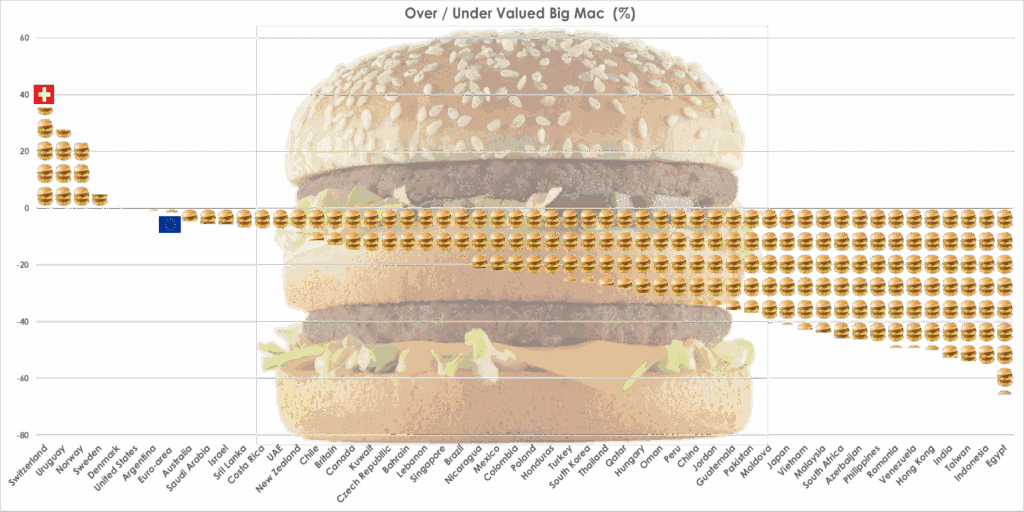
Chart of the Month – Building the perfect mousetrap for capturing alpha

Chart of the Summer – Building the perfect mousetrap for capturing alpha


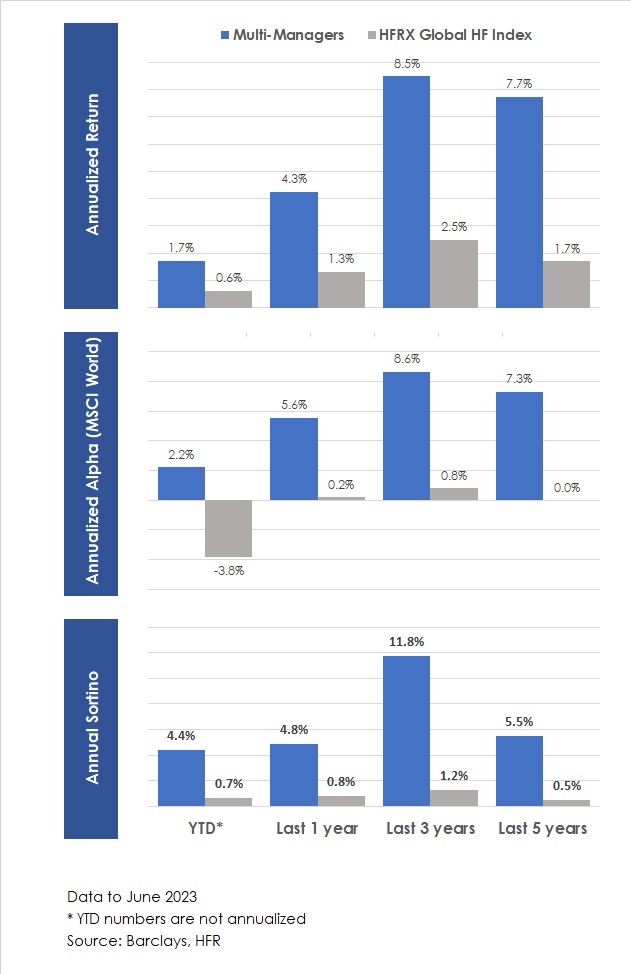
Hedge fund performance overall has been disappointing this year with the HFRX Global Hedge Fund Index barely turning positive YTD as of the end of June. With your typical Balanced 60/40 portfolio up just under 10% YTD (BUT still underwater over the last 2 years!) and cash rates above 5%, hedge funds are facing a big challenge this year as the bogey has changed in the last 9 months. This year has clearly been a year for more directional equity long short managers and less so for market neutral given how narrowly led the market has been (and not only in the US with its Magnificent Seven). In addition to the lack of breadth in the market, the bi-polar factor rotation and sector re-positioning (chronic over the last few years) has caught many managers off guard (blame it on the quant funds – mostly stat arb).

Building a longstanding legacy that is built to last with a clear succession plan to compound returns with consistency over time is more challenging for investment managers that become victims of their success than it is for consumer brands, with the inevitable style drift that comes with a successful track record, as they take in more assets than they can manage, which is the ultimate nail on the coffin. The alternative: the multi-PM model which offers decentralized portfolio management with no single risk-taker able to rock the boat, combined with centralized risk management and the ability to scale in size (to a certain point) where investment opportunities arise. This model has been around since the end of the 1980s and has proved itself over time in compounding consistent returns beyond traditional benchmark indices. This month’s chart compares the Barclays Multimanager Index of 42 multi-PM platforms versus the HFRX Global Hedge Fund Index and highlights why this model has been so successful with investors (mostly pension funds, sovereign wealth funds and private banks). It should be of no surprise that most of the growth in the $4 Trio. hedge fund industry over the last few years has been in the multi-PM space given their ability in providing consistent risk-adjusted performance and more importantly their capacity to protect capital during market drawdowns in comparison to multi-strategy funds led by a single PM that sooner or later stumble and fall before re-jigging their strategy. Their capability in identifying talent and allocating capital efficiently across various strategies has proved itself to a point where the competition for talent has reached extremes and has become a game of musical chairs. Poaching traders between multi-PM platforms has now become like paying for star football players (which does not necessarily guarantee the success of a team, but who cares, if they can score big on their own).  The success of the multi-PM platform model can be further illustrated by the number of PMs that have left some of the oldest and most successful platforms over the last 25 years following a so-called stellar track record but then fail to deliver when they launch on their own. There are countless examples of these which attest to the robustness in the construct of the multi-PM platform.

The significant rise in the risk-free rate of late has somewhat challenged a platform’s ability to generate a high Sharpe ratio in addition to the subpar performance as traditional sub-strategy buckets are not working as well YTD. The most common allocations by sub-strategy within a multi-PM structure and the reason for their underperformance YTD are: Fundamental Equity Long Short (market neutral strategies are going through one of the worst years due to massive short squeezes), Discretionary Macro (tough year to call the direction of rates unless you focus on EM), Merger Arbitrage (less deals as money is no longer cheap and the regulator has taken a tougher stance), Capital Markets (the IPO/SPAC market has dried up and not many new deals) and Systematic Macro (tough year to catch trends and have completely missed the equity market rally). What has worked this year has been Global Credit, Fixed Income RV, Convertibles and unsurprisingly Commodities (where most multi-PM platforms are less exposed). Quant strategies have had mixed results but are an inherent part of the build as a diversifier of alpha sources but often plagued by “love / hate” relationships until they get thrown out and replaced down the line with a new team if they underperform over time. They are, however, better able to perform during periods of market volatility given their shorter-term time horizon.

One could say that there are way too many hedge funds today (more than the 16,041 Starbucks stores in the US alone!) fishing in the same pond for the most part i.e. the US equity market where the number of listed companies has drastically fallen from over 8,000 companies (at its peak in 1996) down to 3,700 today (thanks to private equity groups or bankruptcies). You have the same number of stocks listed in Japan today so go figure why there are barely any hedge funds left trading out of Tokyo (the capital of equity market neutral strategies)! Finding 50 of the best capacity constrained sector PMs is easy but getting 250 is more difficult with the inherent risk of diworsification. The big question today is whether the multitude of multi-PM platforms are arbitraging themselves out. The fact that they have increasing amounts of capital under management, which must be deployed across the same popular sectors and in liquid stocks, have all ended up trading the same equity names. In addition, the average holding period of a stock in the US is down to 10 months down from 5 years back in the 70s. Not surprising that we occasionally see a platform winding down a sector or sub-strategy pod which has breached its risk limits and has had to liquidate, creating a ripple effect across other multi-PM platforms which in turn are forced by their risk control teams to cut risk. The inherent leverage used within these platforms (which varies widely amongst them) to enable them to increase alpha only amplifies the ripple effect.

The big dilemma for platforms today is whether to onboard managers to have exclusivity (which comes at a price and with no performance guarantee) or work with outside independent managers and/or the sell-side. External Alpha-capture programs were first pioneered by Marshall Wace back in 2001 (initially started as a summer internship project) to enable buy-side firms to track and analyze the sell-side’s best ideas. At the time the average lifespan of a contributor was and still is around 4-5 years. Compared to the average lifespan of a PM within one of the oldest multi-pm structures today, it is now down to 17 months (Darwinism!). Perhaps the platforms concentrated down to 20-30 PMs (like the traditional fund of funds model) will do better but their capacity will be constrained. We will always be reminded that size is your biggest enemy. With at least ten new platforms slated to launch this year, the trend is far from over.

Ultimately, it is more of an art than a science and as one manager told me back in the 90s “we all use the same ingredients but it’s the recipe that makes the difference…”


Past performance is not indicative of future results. The views, strategies and financial instruments described in this document may not be suitable for all investors. Opinions expressed are current opinions as of date(s) appearing in this material only. References to market or composite indices, benchmarks or other measures of relative market performance over a specified period of time are provided for your information only. NS Partners provides no warranty and makes no representation of any kind whatsoever regarding the accuracy and completeness of any data, including financial market data, quotes, research notes or other financial instrument referred to in this document. This document does not constitute an offer or solicitation to any person in any jurisdiction in which such offer or solicitation is not authorized or to any person to whom it would be unlawful to make such offer or solicitation. Any reference in this document to specific securities and issuers are for illustrative purposes only, and should not be interpreted as recommendations to purchase or sell those securities. References in this document to investment funds that have not been registered with the FINMA cannot be distributed in or from Switzerland except to certain categories of eligible investors. Some of the entities of the NS Partners Group or its clients may hold a position in the financial instruments of any issuer discussed herein, or act as advisor to any such issuer.  Additional information is available on request.
© NS Partners Group

Gráfico del mes – Burgernomics: el amargo sabor de la inflación

Burgernomics: el amargo sabor de la inflación


Source: The Economist Jan 23’

El índice Big Mac fue inventado por la revista The Economist en 1986 como una «Guía de la inflación para tontos» 19 años después de la creación del Big Mac en 1967 con un precio de 45 céntimos en aquel entonces (hoy cuesta algo más de 6 dólares, un 1,244% más). Eso sucedió justo diez años después de que McDonald’s inaugurase su primera franquicia en Suiza (en Ginebra, el 4 de noviembre de 1976; entonces el Big Mac tenía un precio de 3,90 francos suizos y ahora vale 6,90). El índice pretendía ser una forma divertida de ilustrar el concepto de paridad del poder adquisitivo junto con la inflación del precio de una hamburguesa emblemática reconocida universalmente, sinónimo de la cultura estadounidense y que emplea los mismos ingredientes en todo el mundo. Las variantes locales, como la McRaclette (olvídense del cheddar procesado) o la McBollywood (sin carne de vacuno, por favor) eran las raras excepciones. No hace falta decir tiene que todo lo que tiene que freírse, hornearse o cocinarse se ha disparado de precio en los últimos doce meses.

Como aspecto menos positivo, no hay más que ver el espectacular aumento y caída del poder adquisitivo en EE. UU. (¡atentos a la próxima gran revolución que viene!). En 1980, con el salario mínimo en EE. UU. se podían comprar algo más de seis Big Macs, mientras que en 2022 apenas permite comprar uno (¡teniendo en cuenta los impuestos estatales y municipales!).


1967 1980 2023
Salario mínimo 1,40 USD 3,10 USD 7,25 USD
Precio medio del Big Mac 0,45 USD 0,50 USD 6,05 USD
Big Macs por hora 3,10 6,20 1,20


Todavía me deja perplejo cómo McDonald’s pudo distribuir con semejante éxito su equivalente del Ford Modelo T fabricado en serie (una gama de productos idéntica en todo el mundo). Y no, las mejores hamburguesas no se encuentran necesariamente en Estados Unidos (¡se sorprenderían!). No alcanzo a entender las razones por las que alguien compraría algo que tiene más azúcar, grasas, sal y ácidos grasos saturados que hidratos de carbono, pero ha sobrevivido a la prueba del tiempo y ha acabado con muchos competidores desde su creación en 1955 en California (irónicamente, el estado que se ha convertido en uno de los más sanos y en forma de América). El caso de este grupo de comida rápida que más vende en el mundo y el de mayor éxito en restauración fue objeto de estudio en la Harvard Business School hace 20 años y salió indemne de la reciente pandemia, gracias a sus McAuto®, respetando la distancia social. Desde que empezó a cotizar en bolsa el 21 de abril de 1965, una sola acción comprada a 22,50 dólares valdría ahora nada más y nada menos que 1.201.625 dólares (excluyendo los dividendos, pero teniendo en cuenta los desdoblamientos de acciones).

Además de su valor lúdico, el índice Big Mac tiene sus defectos: la mayor parte del continente africano está fuera del menú, como lo está también Rusia desde el año pasado, al igual que Bielorrusia (por problemas en la cadena de suministro: escasez de patatas fritas). El crecimiento del PIB y los costes laborales son diferentes en todo el mundo (a menudo son reflejo del salario mínimo local) y un artículo no es indicativo de la cesta de la compra habitual que representa el coste de la vida. Sin embargo, sí que refleja el precio de las materias primas, el coste de la mano de obra y la electricidad. También existe una versión del gráfico ajustada al PIB, que modifica algo las estadísticas.

Estar fuera de la zona euro parece tener sus ventajas: países como Suiza, Noruega y Suecia están siempre en la parte más alta de la clasificación. Sin embargo, las últimas clasificaciones muestran que Turquía, Egipto e incluso Gran Bretaña se han desplomado en la clasificación desde el pasado mes de junio, siendo superados por países como Venezuela (que en su día lideró la clasificación, superando tanto a Noruega como a Suiza en 2013). El denominador común es la inflación, que ha afectado mucho más a estos países de forma (Venezuela importa la mayor parte de los alimentos que consume), lo que ha llevado a sus bancos centrales a endurecer la política monetaria con mayor contundencia.

Compren sus Big Mac en bitcoin en algunos lugares del mundo, como El Salvador (e incluso en algunas ciudades de Suiza) ¡y la volatilidad de sus precios se dispara! Y si creía que en Japón no había inflación, McDonald’s ha elevado el precio de su hamburguesa clásica tres veces en menos de un año (un 55%) debido al aumento de los costes y a las fluctuaciones de divisas, pues ¡la inflación acaba de marcar su nivel más alto en 40 años! Resulta paradójico que, a medida que suben los precios de los alimentos, disminuye el número de cenas fuera de casa, lo que beneficia a McDonald’s.

Estén atentos a la próxima publicación del Índice Big Mac dentro de seis meses y prepárense para más sobresaltos. McDonald’s acaba de publicar sus resultados del cuarto trimestre, que han batido las expectativas tanto de ingresos como de beneficios, a pesar de la fortaleza del dólar estadounidense (el grupo genera más ingresos fuera de EE. UU., por lo que hay que prestar atención a la caída del dólar desde finales del año pasado, que mejoraría los datos del próximo trimestre). Un crecimiento de las ventas de dos dígitos en todos los segmentos no está mal en el entorno actual, cuando se tiene cierto poder de fijación de precios.

Cabe esperar que las cosas vayan a peor, con los abundantes cuellos de botella en las cadenas de suministro en todo el mundo debido a la guerra en Ucrania y la inusual triple caída de La Niña (el efecto contrario de El Niño), por tercer año consecutivo, que ha afectado a los cultivos en todo el mundo con sequía extrema, lluvias y huracanes. Todo esto genera el mayor número de oportunidades de toda una generación para los gestores discrecionales macro y de arbitraje, además del fin del prolongado entorno de tipos de interés cero al normalizarse los tipos.

¡Ojalá se pudiera arbitrar el diferencial de un Big Mac…!


Los resultados pasados no implican resultados futuros. Las opiniones, estrategias e instrumentos financieros que se describen en el presente documento pueden no ser convenientes para todos los inversores. Las opiniones expresadas son sólo las del momento en la(s) fecha(s) que aparece(n) en este material. Las referencias a índices de mercado o compuestos, índices de referencia u otras medidas de resultados relativos de los mercados durante un período específico sólo se proveen a título informativo. NS Partners no garantiza ni es responsable de la exactitud o la integridad de las informaciones (datos financieros de mercado, precios de bolsa, resultados de investigación u otros instrumentos financieros) que se mencionan en este documento. El presente documento no constituye una oferta ni solicitud a ninguna persona ni jurisdicción donde tal oferta o solicitud no esté autorizada ni a ninguna persona a quien sería ilegal hacer dicha oferta o solicitud. Toda referencia en este documento a instrumentos específicos o a emisores sólo tiene una finalidad ilustrativa y no debe ser interpretada como una recomendación para la compra o venta de dicho instrumento. Las referencias en este documento a fondos de inversión se aplican a fondos que no han sido registrados por la Finma y que por lo tanto no pueden ser distribuidos en o desde suiza excepto a ciertas categorías de inversores. Algunas de las empresas del grupo NS Partners o sus clientes pueden tener posiciones en los instrumentos financieros de alguno de los emisores mencionados en este documento, o ser asesor de uno de ellos. Hay información adicional disponible a solicitud.

© Grupo NS Partners

Chart of the Month – Burgernomics – A bitter taste of inflation

Burgernomics – A bitter taste of inflation

Source: The Economist Jan 23’

The Big Mac Index was invented by The Economist back in 1986 as a “Guide to Inflation for Dummies” nineteen years following the creation of the Big Mac in 1967 and priced at 45c at the time. (today it will cost just over $6 – up 1,244%). This was exactly ten years after McDonalds had inaugurated its first franchise in Switzerland (in Geneva on November 4th, 1976 – at the time the Big Mac was priced at CHF 3.90 and now worth CHF 6.90). The index was intended to be a cheerful way of illustrating the concept of purchasing power parity together with inflation in the price of a universally recognized iconic burger synonymous with American culture and using the same ingredients globally. Local variants like the McRaclette (forget the processed Cheddar) or the McBollywood (without the beef please) were the rare exceptions. Needless to say, that anything that has to be fried, baked or cooked has seen its priced jacked up by a significant amount in the last 12 months.

On a less brighter note, one can only witness the spectacular rise and fall of purchasing power in the US (watch this space for the next big revolution to come!). In 1980 minimum wage in the US could buy you just over 6 Big Macs whereas in 2022 it could barely buy you one (don’t forget state and city taxes)!


1967 1980 2023
Minimum Wage $1.40 $3.10 $7.25
Big Mac Avg. Price $0.45 $0.50 $6.05
Big Macs per hour 3.10 6.20 1.20


How McDonalds was able to distribute their equivalent of the mass-produced Ford Model T (an identical product range across the globe) so successfully still baffles me. And no, the best burgers are not necessarily found in America (you would be surprised!). Why one would buy something that has more sugar, fat, salt and saturated fatty acids than carbohydrates is a mystery to me, but it has survived the test of time and put many peers out of business since its creation in 1955 in California (ironically the state that has become one of the healthiest and fittest state in America). As the world’s top selling fast food group and most successful restaurant group, it became a Harvard Business School case study 20 years ago and survived the recent pandemic unscathed, thanks to its McDrive® drive-ins, social distancing oblige. Since it’s IPO on April 21st 1965, a single share bought at $22.50 would be now worth a whopping $1,201,625 (excluding dividends but taking to account stock splits)!

Besides its entertainment value, The Big Mac index does have its flaws; most of the African continent is off the menu and Russia is also off the menu since last year as is Belarus (for supply chain issues – scarcity of French fries). GDP growth and labor costs differ across the world (often reflecting the local minimum wage) and one item is not reflective of your typical consumer basket that represents the cost of living. However, it does reflect the price of raw materials, cost of labor and electricity. There is also a GDP adjusted version of the chart which changes the stats somewhat.

Being outside the Euro area appears to have its advantages with the likes of Switzerland, Norway and Sweden consistently on top of the rankings. However, the latest rankings show that Turkey, Egypt and even Britain have fallen precipitously in the rankings since last June only to be beaten downwards by the likes of Venezuela (that once topped the charts beating both Norway and Switzerland back in 2013!). The common denominator is inflation that hit these countries more significantly (Venezuela actually imports most of the food they eat) prompting their central banks to tighten more aggressively.

Buy your Big Mac in Bitcoin in some places around the world like El Salvador (and even some cities in Switzerland) and your price volatility goes off the charts! And if you thought there was no inflation in Japan, McDonalds has hiked the price of the classic burger three times in less than a year (+55%) on surging costs and currency fluctuations as inflation has just hit its highest level in forty years! Ironically as food prices rise, wining & dining out will be on the decline benefitting McDonalds.

Stay tuned for the next release of the Big Mac Index in six months and be prepared for more sticker shock! McDonalds just reported its Q4 earnings which beat expectations on both the top and bottom lines despite the strength of the US dollar (the group generates more revenue outside the US so watch the fall in the USD since the end of last year which would improve the numbers for the next quarter). Double-digit sales growth in all segments is not bad in today’s environment when you have some pricing power.

With bottlenecks in supply chains abundant throughout the world thanks to the war in Ukraine and La Niña (the opposite effect of El Niño) doing a rare triple dip (for the third year in a row) and affecting crops across the globe through extreme drought, rainfall and hurricanes, one can expect things to get worse. All this creates one of the greatest opportunity sets in a lifetime for discretionary macro and arbitrage managers in addition to the end of the prolonged zero interest rate environment as rates normalize.

If only one could arbitrage the spread of a Big Mac…!


Past performance is not indicative of future results. The views, strategies and financial instruments described in this document may not be suitable for all investors. Opinions expressed are current opinions as of date(s) appearing in this material only. References to market or composite indices, benchmarks or other measures of relative market performance over a specified period of time are provided for your information only. NS Partners provides no warranty and makes no representation of any kind whatsoever regarding the accuracy and completeness of any data, including financial market data, quotes, research notes or other financial instrument referred to in this document. This document does not constitute an offer or solicitation to any person in any jurisdiction in which such offer or solicitation is not authorized or to any person to whom it would be unlawful to make such offer or solicitation. Any reference in this document to specific securities and issuers are for illustrative purposes only, and should not be interpreted as recommendations to purchase or sell those securities. References in this document to investment funds that have not been registered with the FINMA cannot be distributed in or from Switzerland except to certain categories of eligible investors. Some of the entities of the NS Partners Group or its clients may hold a position in the financial instruments of any issuer discussed herein, or act as advisor to any such issuer.  Additional information is available on request.
© NS Partners Group

Chart of the Month – Nowhere to run, nowhere to hide

Chart of the month – Nowhere to run, nowhere to hide

chart of the monthThose of you that have aged well will remember the Billboard Hot 100 single “Nowhere to Run” by Martha Reeves & The Vandellas which was released in 1965 by Motown and copied & remixed by many such as The Isley Brothers, Laura Nyro, Michael Bolton and The Commitments (for you younger folks out there). At the time the 60% equities / 40% bonds (“balanced”) portfolio had already been around for over 10 years, invented by Nobel prize winner Harry Markowitz. The classic 60/40 portfolio has delivered an annualized return of 4.54% over the last 28 years with a Sharpe of 0.44. Fast forward to today and the conventional model which has been so successful historically has suddenly been turned on its head and questioned as the benchmark index was down 14.4% YTD as of mid-May! This is the worst synchronized decline for equity and fixed income benchmarks in history. So, have hedge funds finally earned their place at the dinner table? Not the case this year for most of the successful equity long short names in the industry, irrespective of their geographical focus.
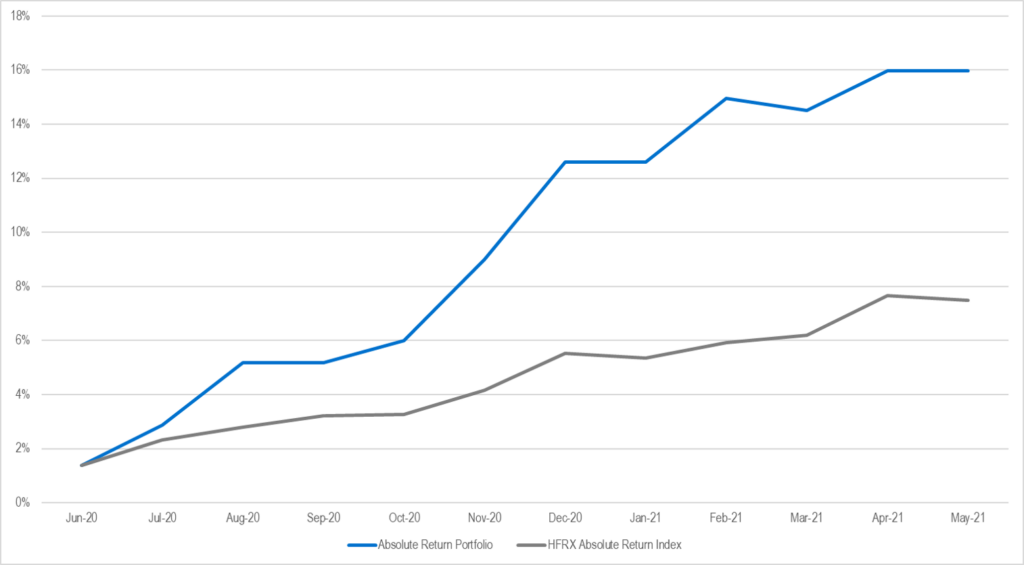
Exactly two years ago, we wrote a piece titled “Survival of the Fittest” which was to be the blueprint for the enhancement of our multi-strategy low volatility mandate which had been running for over 20 years. A year later we wrote the sequel “In Pursuit of Looking Sharpe” after having implemented the changes outlined in our blueprint by adding a number of multi-PM platforms to the portfolio. In summary, the success of the multi-PM model is predicated on their ability of imposing strict stop-loss guardrails in order to prevent drawdowns in addition to being the most efficient allocators of capital to differentiated sources of alpha. Furthermore, multi-PM platforms are increasingly working with external managers enabling them to outperform their peers and produce higher Sharpe ratios (in addition to avoiding high acquisition costs associated with the traditional turf wars between the larger funds). Fast forward to today and as they say “the proof is in the pudding” following two years of live track record in the enhanced mandate. And thus, we truly have an all-weather approach as an alternative to fixed income that enables you to sleep well at night without having to worry about the extreme intra-day moves we have been witnessing of late.

This month’s chart illustrates the sum of all the monthly drawdowns of the MSCI World Index over the last 2 years stacked up against the returns of our multi-strategy low volatility mandate during the same periods. So far, we are pleased with the live crash-test results with a spread of 33.75%, thus making it a viable “alternative” to traditional portfolios. This year Value, Growth and Momentum have been the biggest driver of single stock volatility (and unfortunately Quality has become correlated to Momentum recently) with many of the largest and most successful managers in the equity long / short space witnessing their largest drawdowns of their investment careers. In striking contrast, the equity long / short managers within the multi-PM platforms have been able to perform well due their factor awareness (if not factor neutrality in some cases) together with their low net market exposure.

Remember this famous quote: Crises take much longer to arrive than you believe and they happen much faster than you thought they could (the late Rudi Dornbusch – the economist who graduated from the University of Geneva)!


Past performance is not indicative of future results. The views, strategies and financial instruments described in this document may not be suitable for all investors. Opinions expressed are current opinions as of date(s) appearing in this material only. References to market or composite indices, benchmarks or other measures of relative market performance over a specified period of time are provided for your information only. NS Partners provides no warranty and makes no representation of any kind whatsoever regarding the accuracy and completeness of any data, including financial market data, quotes, research notes or other financial instrument referred to in this document. This document does not constitute an offer or solicitation to any person in any jurisdiction in which such offer or solicitation is not authorized or to any person to whom it would be unlawful to make such offer or solicitation. Any reference in this document to specific securities and issuers are for illustrative purposes only, and should not be interpreted as recommendations to purchase or sell those securities. References in this document to investment funds that have not been registered with the FINMA cannot be distributed in or from Switzerland except to certain categories of eligible investors. Some of the entities of the NS Partners Group or its clients may hold a position in the financial instruments of any issuer discussed herein, or act as advisor to any such issuer.  Additional information is available on request.

© NS Partners Group

Protected: NS Webinar – Pendulum – An all weather alternative.

This content is password-protected. To view it, please enter the password below.

Chart of the Month – Spacaphobia

Spacaphobia


Just as we thought that everyone was SPACked out by now and that the frenzy was over following the first quarter of this year when most SPACs began trading underwater Trump Media & Technology (founded by Mr. Donald Trump in February 2021) merged with Digital World Acquisition Corp. to become the latest meme stock going galactic and gaining 1,657% above its first day close. And until very recently was still the world’s best performing SPAC overtaking Iridium, Lucid Motors, DraftKings and QuantumScape (backed by VW and Bill Gates) to name a few you may have heard of! All you need is to be rich, smart or a celebrity to launch your own SPAC these days. YTD there have been 566 SPACs launched so far (equating to 63% of the capital raised in IPOs this year) and 552 are still searching for a target. More importantly, the amount of capital raised so far this year in SPAC issuance has surpassed the amount raised during the previous 18 years!

As a reminder, a SPAC is a blank-check company, a concept that has been around for the last 25 years but become more popular since last year, COVID oblige. Interestingly, the top five underwriters of SPACs over the last 5 years (a very lucrative business to which you can add leverage a la Archegos given the unlikelihood of losing money) have been Credit Suisse (No. 1 in the last 7 years until this year!), Citigroup, Goldman Sachs, Cantor Fitzgerald and Deutsche Bank. The success of the SPAC market is based on the fact that you can effectively buy a lottery ticket with a money-back guarantee in case you are not satisfied with the purchase (as long as you participate in the initial offering or buy it at or below par on the public market) – the flip side of the “risk-free” ticket is that you may have to wait up to 2 years to get your money back from an interest-bearing trust account if no deal is struck before the expiry date. And if the SPAC does end up finding a perfect match made in heaven with an entity that has no meaningful revenues, you are buying a dream or a moonshot that has a chance of ending very badly.

No surprise that the usual suspects of the hedge fund industry have been the first port of call for SPAC IPOs given the significant assets they manage and their ability to participate in PIPEs in addition to the warrants issued at par that can be traded after 2 months. The net result was that these hedge funds were able to significantly spice up their returns in 2020 with additional percentage points of performance. Despite a less glorious year for SPACs, there are many funds still specializing in the space and most are still performing very well YTD. Many of the multi-strategy hedge funds that historically shied away from the space saw an opportunity in the second quarter as many SPACs traded below their issue price creating a pull-to-par trade on a levered basis that has proved to be very profitable. At the end of September alone, 97% of SPACs outstanding were trading below par.

What many investors fail to realize is that PIPEs (Private Investment in Public Equity) are the most important part of the puzzle as the sponsors need to raise 2-3 times more money than what they get in the SPAC IPO for an acquisition to be viable. In come the hedge fund platforms (again) that can get a sneak preview and negotiate a better deal spiced up with the likes of preferred equity. The SPAC model is once again undermined if the PIPE financing fails to materialize potentially causing the share price to collapse.

Sky’s the limit when one gets into IPOs within the electric automotive industry’s Tesla wannabe’s (Amazon-backed Rivian Automotive being the latest one to become public via an IPO as opposed to a SPAC and valued as the 3rd largest auto company in the world by market cap in less than 4 trading days!). However, most of the 15 EV SPACs that have gone public since the start of 2020 (with the exception of Polestar and Lucid Motors) have seen their battery power run dry as they failed to meet their moonshot expectations. Examples include Fisker (one of the world’s first production luxury hybrid EV which already went bankrupt once even though they had the technology and the design at the time – Fisker had designed BMW’s Z8 roadster for Mr. Bond!) whilst Nikola Corp. and Lordstown Motors have been accused of “misleading” investors.

Contrast that with today’s fastest accelerating all-electric hyper car maker Rimac Automobili, another successful company created 12 years ago in the back of a garage by a 19-year old Croatian. If you are successful why would you want to raise money from strangers who are likely to pump and dump the SPAC once a reverse-merger is announced (or shortly after) when there is so much money in private equity waiting on the sidelines not to mention a potential acquiror that is already listed? Bugatti Rimac is the latest example, a joint venture between Porsche and Rimac which will eventually list next year (Bugatti will have to kiss goodbye to its 112-year petrol engine racing heritage culminating with the 8.0-litre W16 Chiron AND move its headquarters from Molsheim to Zagreb – goodbye la France!). Rimac’s founder (together with Elon Musk) was already a vivid critic of EV SPACs back in 2020 and rightly so given how challenging it is to be profitable.

In technology, the new kids on the block will always try to be more innovative than incumbents, but a SPAC is not a science project with a potential for future revenues and thus companies will need to become more serious and mature before listing. There is no reason for a SPAC to trade above its issue price before a deal is announced but as recent market participants have been playing musical chairs in FOMO (Fear Of Missing Out) we will likely have lots of disappointments to come. In addition, half of this year’s IPOs above $1 bio. are busted and trading underwater One thing is sure though, the sponsors and insiders will always make more money for themselves and the regulators will intervene at some point when it’s too late. Until then, “let the music play on…” (Barry White, 1976).


Past performance is not indicative of future results. The views, strategies and financial instruments described in this document may not be suitable for all investors. Opinions expressed are current opinions as of date(s) appearing in this material only.

References to market or composite indices, benchmarks or other measures of relative market performance over a specified period of time are provided for your information only. NS Partners provides no warranty and makes no representation of any kind whatsoever regarding the accuracy and completeness of any data, including financial market data, quotes, research notes or other financial instrument referred to in this document.

This document does not constitute an offer or solicitation to any person in any jurisdiction in which such offer or solicitation is not authorized or to any person to whom it would be unlawful to make such offer or solicitation. Any reference in this document to specific securities and issuers are for illustrative purposes only, and should not be interpreted as recommendations to purchase or sell those securities. References in this document to investment funds that have not been registered with the FINMA cannot be distributed in or from Switzerland except to certain categories of eligible investors. Some of the entities of the NS Partners Group or its clients may hold a position in the financial instruments of any issuer discussed herein, or act as advisor to any such issuer.

 Additional information is available on request.

© NS Partners Group

Chart of the Month – In Pursuit Of Looking Sharpe

CHART OF THE MONTH – In Pursuit Of Looking Sharpe

Source: Bloomberg, Notz Stucki

Many readers will remember the golden decade of hedge funds (the 1990s) that ended with the publication of “In Search of Alpha – Investing in Hedge Funds” the first of a series by the infamous Alexander Ineichen of UBS (a training manual for the latest incoming summer intern eager to learn about the mysteries of hedge funds) published a few months before the burst of the dot-com bubble in the year 2000.

Times have evolved since then, as changes in regulation have been a game-changer (Reg FD and the Volcker Rule to name a few). In addition, market participants have evolved due to the influx of institutional capital in the space and market dynamics have evolved as the average holding period of investments have become much shorter (thanks to increasing impact of the quants, artificial intelligence, geo-political events and Robinhood/Reddit platforms). The hedge fund investor base has also changed dramatically as Geneva, once the center of the world for hedge fund managers seeking capital from private banking HNW clients, has been overtaken by the largest pension, endowment and sovereign wealth funds which have taken the lion’s share of the industry.

Fast forward 10 years to the 2010s and you have the “lost decade” of hedge funds (proprietary desks disappeared, QE infinity made shorting very challenging and mutual funds / ETFs were in hindsight the obvious way to play the longest equity bull market in history). Will 2020 mark another golden decade for hedge funds? It certainly started nicely but proving to be less of a walk in the park so far this year!

Our dedicated absolute return mandate was launched 23 years ago using a multi-strategy approach and designed with the objective of generating consistent low volatility returns through periods of rain or shine, however it did face some difficulties during periods of black swan events like many of its peers. The FoF’s historical recipe for success had been in concentrating portfolios with the most talented single strategy managers in which you had the highest conviction. The downside of this approach is that you can become more volatile at times and before you realize one of your managers is down, it’s too late and it will take you a further 3 months to get out at best, or a year if not more (thanks to the infamous gate) together with the right to inherit a side pocket or two that will take 10 years to liquidate.

Twelve months ago, we wrote a piece entitled “Survival of the Fittest, a Darwinian Approach to Hedge Funds” which was to be the catalyst in undertaking a number of changes to significantly enhance the existing portfolio and make it more robust in market drawdowns and hence improve its Sharpe ratio (and Sortino). The result over the last 12 months have been promising as the Sharpe ratio generated has been 3.75 (which will probably never be repeated!) but more importantly the drawdown has been limited to 39 basis points with 4 of the last 6 months witnessing the worst alpha destruction in the equity space since records began. The changes have focused primarily on diversifying the portfolio across strategies, some of them being more niche and less scalable (therefore less accessible to pension funds/endowments) and having a risk management process based on the idea of the “electrified fence” whereby managers who reach their maximum drawdown limit will have their exposure taken down to zero and it’s “game over”. Add first loss capital arrangements and you take the concept of capital protection to the next level. Hence the multi-PM approach we described in our last piece which will enable us to limit drawdowns and compound returns over time increasingly outperforming the benchmark index over time. Our Multi-strategy and Equity Arbitrage allocations are complemented by what we consider some of the best managers in Credit Arbitrage and Discretionary Macro with a proprietary trading mentality in order to create a four-cylinder vehicle (ESG oblige). Most of our readers may have noticed the impressive comeback in discretionary macro managers in the last two years (a strategy Notz Stucki has been involved in over 50 years of investing in hedge funds and part of its DNA).

With the moves in the bond market together with the equity market’s shifts from growth to value as unpredictable as European weather of late, we hope to prove that our all-weather approach will have a better future as market volatility is here to stay. Let’s face it, what other alternative to fixed income do you have today?

Allow me to end this piece with a quote from Charles Darwin: “It is not the strongest of the species that survives, nor the most intelligent that survives. It is the one that is the most adaptable to change.”


Past performance is not indicative of future results. The views, strategies and financial instruments described in this document may not be suitable for all investors. Opinions expressed are current opinions as of date(s) appearing in this material only.

References to market or composite indices, benchmarks or other measures of relative market performance over a specified period of time are provided for your information only. Notz, Stucki provides no warranty and makes no representation of any kind whatsoever regarding the accuracy and completeness of any data, including financial market data, quotes, research notes or other financial instrument referred to in this document.

This document does not constitute an offer or solicitation to any person in any jurisdiction in which such offer or solicitation is not authorized or to any person to whom it would be unlawful to make such offer or solicitation. Any reference in this document to specific securities and issuers are for illustrative purposes only, and should not be interpreted as recommendations to purchase or sell those securities. References in this document to investment funds that have not been registered with the FINMA cannot be distributed in or from Switzerland except to certain categories of eligible investors. Some of the entities of the Notz Stucki Group or its clients may hold a position in the financial instruments of any issuer discussed herein, or act as advisor to any such issuer.

 Additional information is available on request.

© Notz Stucki Group